Physics for Electrical Engineering: Unit III: Semiconductors and Transport Physics
Part A - 2 Marks Questions and Answer
Semiconductors and Transport Physics | Physics for Electrical Engineering
Physics for Electrical Engineering: Unit III: Semiconductors and Transport Physics : Part - A '2' Marks Q and A Anna university Q and A
Part - A '2' Marks Q & A
ANNA UNIVERSITY Q&A
1.
What are elemental semiconductors? Give some important elemental
semiconductors. (A.U Dec 2014)
Elemental
semiconductors are made from single element of the fourth group elements of the
periodic table.
Example
Germanium
and silicon.
2.
What are the properties of semiconductors? (A.U. June
2013)
•
They are formed by covalent bond.
•
They have empty conduction band.
•
They have almost filled valence band.
•
These materials have comparatively narrow energy gap.
3.
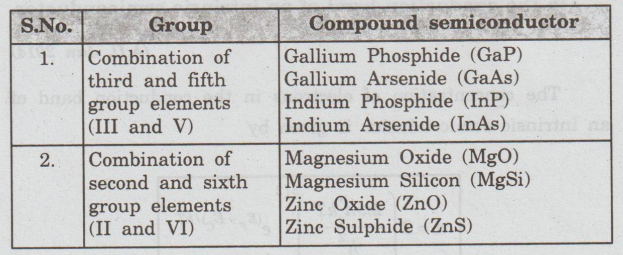
What are compound semiconductors? Give some important compound semiconductors.
(A.U April 2015)
Semiconductors
which are formed by combining third and fifth group elements or second and
sixth group elements in the periodic table are called compound semiconductors.
4.
Mention any four advantages of semiconducting materials. (April 2013, April 2014)
•
It behaves as insulator at 0 K and as conductor at high temperatures.
•
It has some properties of both conductor and insulator.
•
On doping, n and p-type semiconductors
are produced with charge carriers of electrons and holes respectively.
•
It has many applications in electronic field such as manufacturing of diodes,
transistors, LED's, IC etc.
5.
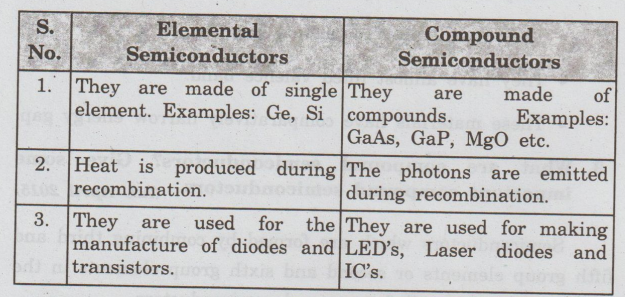
What Physics for Electrical Engineering are the differences between elemental
(A.U June 2012, April 2014, Dec 2015)
6.
Write an expression for the concentration of electrons in the conduction band
of an intrinsic semiconductor. (A.U. Jan 2014)
The
concentration of electrons in the conduction band of an intrinsic semiconductor
is given by
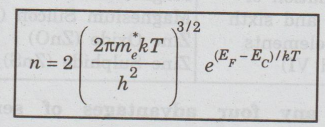
where
me → effective mass of electron
EF
→ Fermi energy level
Ec
→ Energy corresponds to the bottom of conduction band
T
→ Absolute temperature
7.
Write an expression for the concentration of holes in the valence band of an
intrinsic semiconductor.
(A.U.
May 2015)
The
concentration of holes in the valence band is given by
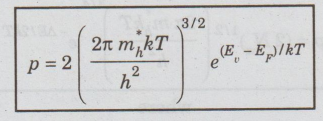
mh
→ effective mass of hole
T
→ absolute temperature.
EF
→ Fermi energy
Ev
→ Energy corresponds to the top of valence band
8.
Write an expression for carrier concentration in n-type semiconductor. (A.U.
May 2015)
The
carrier concentration in n-type semiconductor is given by
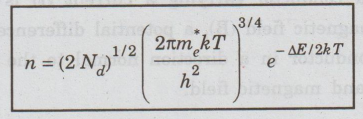
where
ΔE
→ EC – Ed Ionisation energy of the donor
Nd
→ Number of donor atoms per unit volume of the material.
me
→ Effective mass of an electron.
T
→ Absolute temperature
9.
Write an expression for carrier concentration of holes in the valence band of
p-type semiconductor.
(A.U.
Jan 2014)
The
carrier concentration in p-type is given by
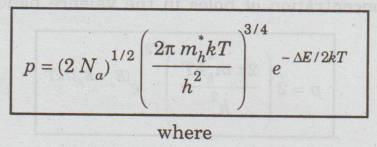
where
ΔE
= (Ev - Eɑ) ionisation energy of acceptor level
mh
→ Effective mass of hole
Nɑ
→ Number of acceptor atoms per unit volume of the material.
T
→ Absolute temperature.
10.
Define Hall-effect and Hall voltage. (A.U. May 2015, Dec 2016)
When
a conductor carrying a current (I) is placed in a transverse magnetic field
(B), a potential difference is produced inside the conductor in a direction
normal to the directions of the current and magnetic field.
This
phenomenon is known as Hall-effect and the generated voltage is called
Hall-voltage.
11.
Mention the uses of Hall effect. (A.U. May 2013, June 2014)
•
It is used to find type of semiconductor.
•
It is used to measure carrier concentration.
•
It is used to find mobility of charge carrier.
•
It is used to measure the magnetic flux
density using a semiconductor sample of known Hall coefficient.
12.
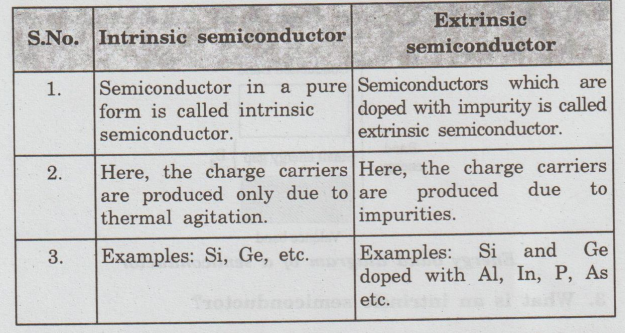
What are the differences between intrinsic and extrinsic semiconductor? (A.U
2008, June 2009, 2012)
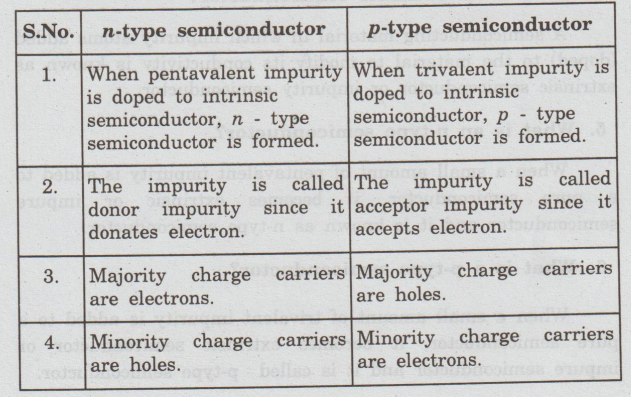
13. What are the differences between n-type and p-type semiconductor?
Physics for Electrical Engineering: Unit III: Semiconductors and Transport Physics : Tag: : Semiconductors and Transport Physics | Physics for Electrical Engineering - Part A - 2 Marks Questions and Answer
Physics for Electrical Engineering: Unit III: Semiconductors and Transport Physics
Under Subject
Physics for Electrical Engineering
PH3202 2nd Semester 2021 Regulation | 2nd Semester EEE Dept 2021 Regulation
Related Subjects
Professional English II
HS3251 2nd Semester 2021 Regulation | 2nd Semester Common to all Dept 2021 Regulation
Statistics and Numerical Methods
MA3251 2nd Semester 2021 Regulation M2 Engineering Mathematics 2 | 2nd Semester Common to all Dept 2021 Regulation
Engineering Graphics
GE3251 eg 2nd semester | 2021 Regulation | 2nd Semester Common to all Dept 2021 Regulation
Physics for Electrical Engineering
PH3202 2nd Semester 2021 Regulation | 2nd Semester EEE Dept 2021 Regulation
Basic Civil and Mechanical Engineering
BE3255 2nd Semester 2021 Regulation | 2nd Semester EEE Dept 2021 Regulation
Electric Circuit Analysis
EE3251 2nd Semester 2021 Regulation | 2nd Semester EEE Dept 2021 Regulation
Physics for Electronics Engineering
PH3254 - Physics II - 2nd Semester - ECE Department - 2021 Regulation | 2nd Semester ECE Dept 2021 Regulation
Electrical and Instrumentation Engineering
BE3254 - 2nd Semester - ECE Dept - 2021 Regulation | 2nd Semester ECE Dept 2021 Regulation
Circuit Analysis
EC3251 - 2nd Semester - ECE Dept - 2021 Regulation | 2nd Semester ECE Dept 2021 Regulation
Materials Science
PH3251 2nd semester Mechanical Dept | 2021 Regulation | 2nd Semester Mechanical Dept 2021 Regulation
Basic Electrical and Electronics Engineering
BE3251 2nd semester Mechanical Dept | 2021 Regulation | 2nd Semester Mechanical Dept 2021 Regulation
Physics for Civil Engineering
PH3201 2021 Regulation | 2nd Semester Civil Dept 2021 Regulation
Basic Electrical, Electronics and Instrumentation Engineering
BE3252 2021 Regulation | 2nd Semester Civil Dept 2021 Regulation
Physics for Information Science
PH3256 2nd Semester CSE Dept | 2021 Regulation | 2nd Semester CSE Dept 2021 Regulation
Basic Electrical and Electronics Engineering
BE3251 2nd Semester CSE Dept 2021 | Regulation | 2nd Semester CSE Dept 2021 Regulation
Programming in C
CS3251 2nd Semester CSE Dept 2021 | Regulation | 2nd Semester CSE Dept 2021 Regulation