Physics for Electrical Engineering: Unit III: Semiconductors and Transport Physics
Semiconductors
Introduction, Definition, Classification, Characteristics, Uses
Semiconducting material has electrical conductivity between a good conductor and a good insulator. It is simply called semiconductor. It is a special class of material which is very small in size and sensitive to heat, light and electricity.
Unit –
III
Chapter -
3
Semiconductors
and Transport Physics
Intrinsic
Semiconductors - Energy band diagram- direct and indirect band gap
semiconductors - Carrier concentration
in intrinsic semiconductors – extrinsic semiconductors - Carrier concentration
in N-type & P-type semiconductors - Variation of carrier concentration with
temperature - Carrier transport in Semiconductors: Drift, mobility and
diffusion - Hall effect and devices - Ohmic contacts - Schottky diode.
Introduction
Semiconducting
material has electrical conductivity between a good conductor and a good
insulator. It is simply called semiconductor. It is a special class of material which is very small in size and
sensitive to heat, light and electricity.
Semiconducting
materials behave insulators at low temperature and as conductors at high
temperature. Moreover, these materials have two types of charge carriers i.e., electrons and holes.
Germanium
and silicon are two important
elemental semiconductors. They are used in diodes and transistors.de
Gallium arsenide (GaAs) and indium
phosphide (InP) are two important compound
semiconductors. They are used in LEDs and Laser diodes.
The
study of semiconducting materials is essential for engineers due to their wide
applications in semiconductor devices in engineering and technology.
The
invention of semiconductors opened a new branch of technology called solid state electronics.
It
leads to the development of ICs, microprocessors, computers and supercomputers.
In
short, semiconductors play a vital role in almost all advanced electronic
devices.
Definition
Based on Electrical resistance
Semiconductor
has electrical resistance which is lesser than an insulator but more than that
of a conductor. Its electrical resistivity is in the order of 10-4
to 0.5 ohm metre.
Based on Energy band
A
semiconductor has nearly an empty conduction band and almost filled valence
band with a very small energy gap (≈ 1 eV). (Fig 3.1)
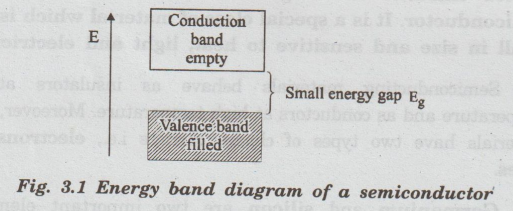
General properties of the semiconductors
•
They have crystalline structure.
•
Bonding between the atoms is formed by covalent bond.
•
They have empty conduction band at 0K.
•
They have almost filled valence band.
•The
energy gap is small.
•
They exhibit a negative temperature coefficient of resistance. ie., increase in
temperature leads to decrease in resistance.
• If impurities are added to a
semiconductor, its electrical increases. conductivity Further, temperature of
the semiconductor is increased, its electrical conductivity increases.
This property is in contrary to
that of metals in which if temperature is increased or impurities are added,
their electrical conductivity decreases.
Classification of semiconductors
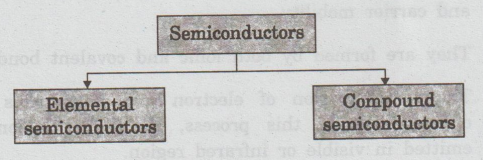
The
semiconductors are classified mainly into two types based on the composition of
materials. They are
(i) Elemental semiconductors
(ii) Compound semiconductors
Elemental Semiconductors (Indirect band gap semiconductor)
The
semiconductors which are made from a single element of fourth group elements in
periodic table are known as elemental semiconductors.
They
are also called as indirect band gap semiconductors.
Example
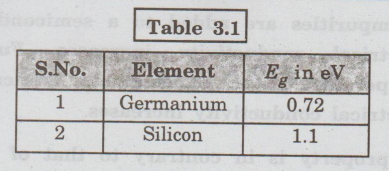
Two
important elemental semiconductors and their energy band gaps are given in
table 3.1.
Compound semiconductors (Direct
band gap semiconductors)
Semiconductors
which are formed by combining third and fifth group or second and sixth group
elements in the periodic table are known as compound semiconductors.
They
are also called as direct bandgap semiconductors.
Characteristics
•
The compound semiconductor have large forbidden gap and carrier mobility.
•
They are formed by both ionic and covalent bonds.
•
The recombination of electron and hole takes place directly. During this
process, the light photons are emitted in visible or infrared region.
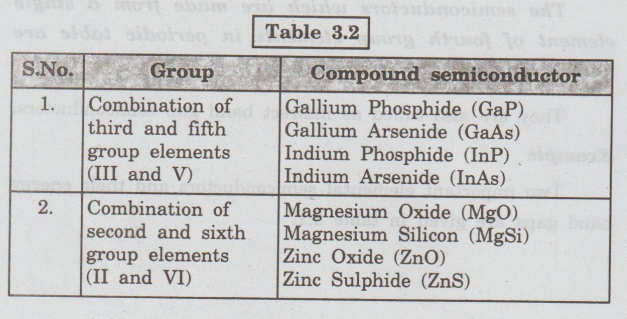
Some
important compound semiconductors are given in table 3.2.
Uses
The
compound semiconductors are used in photovoltaic cell, photoconductive cell,
LEDs [Light Emitting Diode] and Laser diodes.
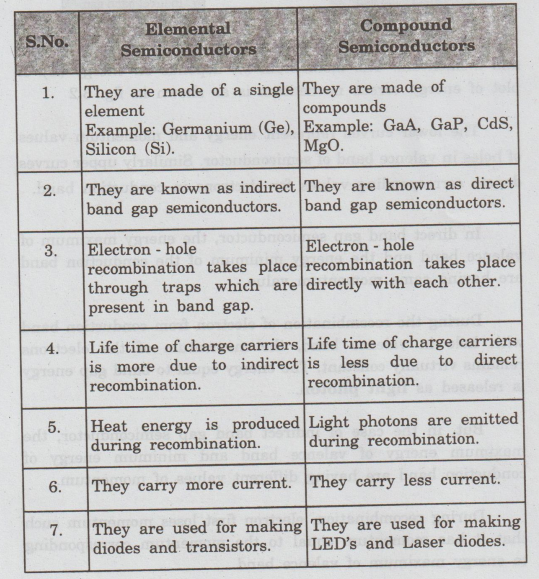
Table 3.3
Differences
between elemental and compound semiconductors (indirect and direct band gap semiconductors)
Physics for Electrical Engineering: Unit III: Semiconductors and Transport Physics : Tag: : Introduction, Definition, Classification, Characteristics, Uses - Semiconductors
Physics for Electrical Engineering: Unit III: Semiconductors and Transport Physics
Under Subject
Physics for Electrical Engineering
PH3202 2nd Semester 2021 Regulation | 2nd Semester EEE Dept 2021 Regulation
Related Subjects
Professional English II
HS3251 2nd Semester 2021 Regulation | 2nd Semester Common to all Dept 2021 Regulation
Statistics and Numerical Methods
MA3251 2nd Semester 2021 Regulation M2 Engineering Mathematics 2 | 2nd Semester Common to all Dept 2021 Regulation
Engineering Graphics
GE3251 eg 2nd semester | 2021 Regulation | 2nd Semester Common to all Dept 2021 Regulation
Physics for Electrical Engineering
PH3202 2nd Semester 2021 Regulation | 2nd Semester EEE Dept 2021 Regulation
Basic Civil and Mechanical Engineering
BE3255 2nd Semester 2021 Regulation | 2nd Semester EEE Dept 2021 Regulation
Electric Circuit Analysis
EE3251 2nd Semester 2021 Regulation | 2nd Semester EEE Dept 2021 Regulation
Physics for Electronics Engineering
PH3254 - Physics II - 2nd Semester - ECE Department - 2021 Regulation | 2nd Semester ECE Dept 2021 Regulation
Electrical and Instrumentation Engineering
BE3254 - 2nd Semester - ECE Dept - 2021 Regulation | 2nd Semester ECE Dept 2021 Regulation
Circuit Analysis
EC3251 - 2nd Semester - ECE Dept - 2021 Regulation | 2nd Semester ECE Dept 2021 Regulation
Materials Science
PH3251 2nd semester Mechanical Dept | 2021 Regulation | 2nd Semester Mechanical Dept 2021 Regulation
Basic Electrical and Electronics Engineering
BE3251 2nd semester Mechanical Dept | 2021 Regulation | 2nd Semester Mechanical Dept 2021 Regulation
Physics for Civil Engineering
PH3201 2021 Regulation | 2nd Semester Civil Dept 2021 Regulation
Basic Electrical, Electronics and Instrumentation Engineering
BE3252 2021 Regulation | 2nd Semester Civil Dept 2021 Regulation
Physics for Information Science
PH3256 2nd Semester CSE Dept | 2021 Regulation | 2nd Semester CSE Dept 2021 Regulation
Basic Electrical and Electronics Engineering
BE3251 2nd Semester CSE Dept 2021 | Regulation | 2nd Semester CSE Dept 2021 Regulation
Programming in C
CS3251 2nd Semester CSE Dept 2021 | Regulation | 2nd Semester CSE Dept 2021 Regulation