Basic Civil & Mechanical Engineering: UNIT II: q. Modern materials
Smart materials
Civil Engineering Materials
The smart materials used in built environment can be defined as those offering specific functional and adaptable properties in response to thermal, optical, structural, and environmental stimuli.
SMART MATERIALS
Basically,
smart material is the one that reacts quickly to a stimulus in a specific
manner. The change in the material can also be reversible, as a change in
stimulus can bring the material back to its previous state. The smart materials
used in built environment can be defined as those offering specific functional
and adaptable properties in response to thermal, optical, structural, and
environmental stimuli. These materials not only enhance the overall
performances of new building construction, but also promise safer structures,
longer durability of building elements, more building energy savings, greater
environmental sustainability, and even higher indoor user comfort.
The
structures which make use of smart materials are known as smart structures. The
two commonly used smart materials are piezoelectric materials and
electrorheological fluids.
1. PIEZOELECTRIC MATERIALS
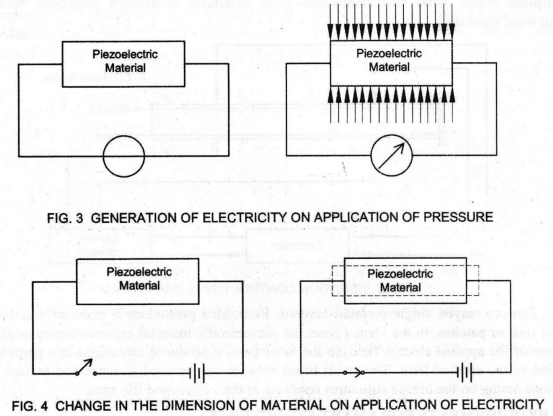
Piezoelectric
materials are the widely used smart materials. They produce voltage when
surface strain is introduced as shown in Fig. 3. Also, the materials undergo
surface elongation when an electric field is applied across them as shown in
Fig. 4.
The
materials exhibiting piezoelectric property are non-metallic materials such as
quartz, rock salt and tairmalite. Polyvnylidene fluoride, which can be easily
formed into thin sheets and adhere to any surface is very commonly used smart
material.
2. ELECTRORHEOLOGICAL FLUIDS
Electrorheological
fluids are colloidal suspensions that exhibit reversible change in viscosity
when subjected to an electric field. The property of reversible transition from
liquid to solid state is utilized in many engineering applications. These
changes could be reversed in time intervals of the order of a few milliseconds.
3. FUNCTIONALITY OF SMART STRUCTURES
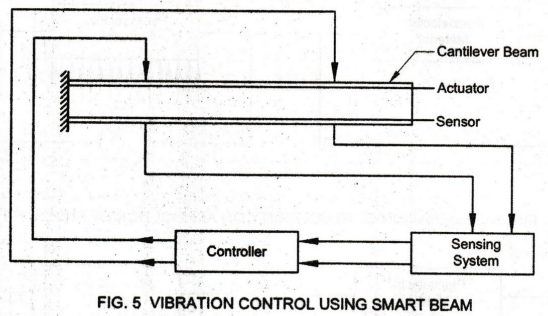
A
smart structure has four major components, namely, the structure, sensor,
actuator, and controller as shown in Fig. 5. Actuators and sensors are widely
used in various applications and are generally integrated with main structures
via surface bonding or embedding. The piezoelectric sensor is bonded to the
surface of the beam using a small strip of two-sided adhesive tape. It detects
the vibration and sends signal to the controller. Subsequently, the controller
sends corrective signal to the piezoelectric actuator. The actuator in turn
applies local strain to the beam and thereby the effect of vibration is
minimized.
The
above smart beam concept is used in civil structures like bridges to dampen the
vibrations produced due to earthquake. The concept is also used in applications
like helicopter and airplane wings, wind mill blades and space structures to
dampen vibrations induced by varying wind velocities.
Sensors
maybe single or multi-layered. Embedded piezoelectric material may be in the
form of rods or patches. In the former case, the piezoelectric material
expands/contracts along the direction of the applied electric field. In the
latter case, it produces extensions in a perpendicular direction to the applied
field. The smart beam concept can be used to sense and reduce vehicle
vibrations acting on the bridge structures resulting in their improved life
span.
4. REQUIREMENTS FOR SMART STRUCTURES
The
smart structures provide the following attributes:
1.
High degree of reliability, efficiency and sustainability for structures.
2.
High security to the infrastructures particularly when subjected to extreme and
unconventional conditions.
3.
Continuous health and integrity monitoring.
4.
Damage detection and self-recovery.
5.
Intelligent operational management system.
Basic Civil & Mechanical Engineering: UNIT II: q. Modern materials : Tag: : Civil Engineering Materials - Smart materials
Basic Civil & Mechanical Engineering: UNIT II: q. Modern materials
Under Subject
Basic Civil and Mechanical Engineering
BE3255 2nd Semester 2021 Regulation | 2nd Semester EEE Dept 2021 Regulation
Related Subjects
Professional English II
HS3251 2nd Semester 2021 Regulation | 2nd Semester Common to all Dept 2021 Regulation
Statistics and Numerical Methods
MA3251 2nd Semester 2021 Regulation M2 Engineering Mathematics 2 | 2nd Semester Common to all Dept 2021 Regulation
Engineering Graphics
GE3251 eg 2nd semester | 2021 Regulation | 2nd Semester Common to all Dept 2021 Regulation
Physics for Electrical Engineering
PH3202 2nd Semester 2021 Regulation | 2nd Semester EEE Dept 2021 Regulation
Basic Civil and Mechanical Engineering
BE3255 2nd Semester 2021 Regulation | 2nd Semester EEE Dept 2021 Regulation
Electric Circuit Analysis
EE3251 2nd Semester 2021 Regulation | 2nd Semester EEE Dept 2021 Regulation
Physics for Electronics Engineering
PH3254 - Physics II - 2nd Semester - ECE Department - 2021 Regulation | 2nd Semester ECE Dept 2021 Regulation
Electrical and Instrumentation Engineering
BE3254 - 2nd Semester - ECE Dept - 2021 Regulation | 2nd Semester ECE Dept 2021 Regulation
Circuit Analysis
EC3251 - 2nd Semester - ECE Dept - 2021 Regulation | 2nd Semester ECE Dept 2021 Regulation
Materials Science
PH3251 2nd semester Mechanical Dept | 2021 Regulation | 2nd Semester Mechanical Dept 2021 Regulation
Basic Electrical and Electronics Engineering
BE3251 2nd semester Mechanical Dept | 2021 Regulation | 2nd Semester Mechanical Dept 2021 Regulation
Physics for Civil Engineering
PH3201 2021 Regulation | 2nd Semester Civil Dept 2021 Regulation
Basic Electrical, Electronics and Instrumentation Engineering
BE3252 2021 Regulation | 2nd Semester Civil Dept 2021 Regulation
Physics for Information Science
PH3256 2nd Semester CSE Dept | 2021 Regulation | 2nd Semester CSE Dept 2021 Regulation
Basic Electrical and Electronics Engineering
BE3251 2nd Semester CSE Dept 2021 | Regulation | 2nd Semester CSE Dept 2021 Regulation
Programming in C
CS3251 2nd Semester CSE Dept 2021 | Regulation | 2nd Semester CSE Dept 2021 Regulation