Physics for Electrical Engineering: Unit I: Dielectric Materials and Insulation
Types of dielectric breakdown
Some important types of dielectric breakdown in solid are (i) Intrinsic breakdown and avalanche breakdown (ii) Thermal breakdown (iii) Chemical and electrochemical breakdown (iv) Discharge breakdown (v) Defect breakdown
Types of dielectric
breakdown
Some
important types of dielectric breakdown in solid are
(i) Intrinsic breakdown and avalanche
breakdown
(ii) Thermal breakdown
(iii) Chemical and electrochemical
breakdown
(iv) Discharge breakdown
(v) Defect breakdown
(i) Intrinsic breakdown
In
dielectric, the charge displacement increases with increasing electrical field
strength.
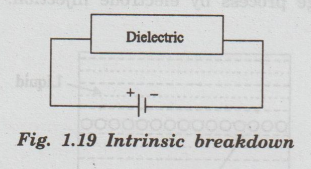
Beyond
a critical value of electrical field strength, there is an electrical breakdown
due to physical deterioration in dielectric material (fig. 1.19).
When
the applied electrical field is large, some of the electrons in the valence
band cross over to the conduction band across the large forbidden energy gap.
They become conduction electrons producing large conduction current.
As
a result, a large current flows through the dielectric and breakdown occurs.
This type of breakdown is called intrinsic breakdown.
Avalanche breakdown
The
conduction electrons are accelerated to very high Jos at wo velocity and energy
on further application of electrical field.
These
conduction electrons collide with valence electrons in the covalent bond and
they transfer their energy to valence electron. The valence electrons on
acquiring this energy, jump from the valence band to the conduction band.
This
process continues as more and more valence electrons jump to the conduction
band by breaking the covalent bond.
As
a result, a large current flows through the dielectric and breakdown occurs.
This type of breakdown is called Avalanche breakdown.
Characteristics
•
Intrinsic and avalanche breakdowns require large electrical field.
•
They occur even at low temperatures (about room temperature and at lower
temperature).
•
They do not depend on the size and shape of the dielectric material and
configuration of electrodes.
•
They can occur in thin samples.
•
They occur within a short span of time (microseconds).
(ii) Thermal breakdown
When
an electric field is applied to a dielectric material, some amount of heat is
produced. This heat must be dissipated from the material.
In
some cases, the amount of heat produced is very large as compared to the heat
dissipated. Due to excess of heat, the temperature inside the dielectric
increases and may produce local melting in the dielectric material.
During
this process, a large amount of current flows through the material and causes
the dielectric to breakdown. This type of breakdown is known as thermal
breakdown.
Characteristics
•
This type of breakdown occurs only at high temperatures.
•
The strength of the electrical field to create dielectric breakdown depends
upon the size and shape of the dielectric sample.
•
The breakdown time is of the order of few milliseconds.
•
It requires moderate electrical fields.
(iii) Chemical and Electrochemical breakdown
Electrochemical
breakdown is similar to thermal breakdown. When the temperature of a dielectric material
increases, mobility of ions increases and hence the electrochemical reaction
may take place.
This
leads to leakage current and energy loss in the material and finally dielectric
breakdown occurs. add to aqada bas sie bas ssie sdt no basqeb
This
type of breakdown is known as chemical and electrochemical breakdown.
Characteristics
•
It occurs even at low temperatures.
•
It depends on the concentration of ions and magnitude Ishots of leakage
current.
(iv) Discharge breakdown
Discharge
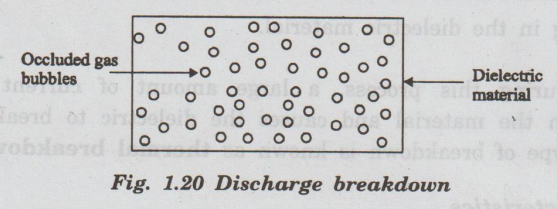
breakdown occurs when a dielectric contains occluded gas bubbles (fig. 1.20).
When this type of dielectric is subjected to electrical field, the gases
present in the material will easily ionise and thus produce large ionisation
current.
The
gaseous ions bombard the solid dielectric. This causes electrical deterioration
and leads to dielectric breakdown. This is known as discharge breakdown.
Characteristics
•
This breakdown occurs at low voltages.
•
It occurs in the dielectric material where there are a large number of occluded
gas bubbles.
•
When discharge takes place at a point, the surrounding places are burnt and
hence their electrical properties are affected.
Thus,
the life of an insulating material depends upon the number of discharges which
are taking place inside the material. That is, it depends upon the frequency of
applied voltage.
(v) Defect breakdown
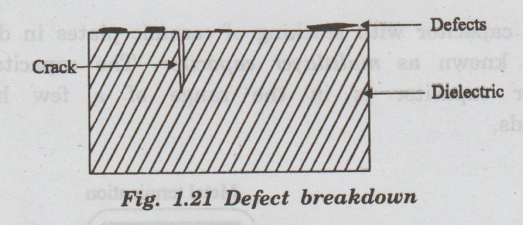
The
surface of the dielectric material may have defects such as cracks, porosity
and blow holes (fig. 1.21). Impurities like dust or moisture may present at
these discontinuities (defects). This leads to a breakdown in a dielectric
material.
Partial
discharges can locally melt the insulator and can easily cause chemical
transformations.
Physics for Electrical Engineering: Unit I: Dielectric Materials and Insulation : Tag: : - Types of dielectric breakdown
Physics for Electrical Engineering: Unit I: Dielectric Materials and Insulation
Under Subject
Physics for Electrical Engineering
PH3202 2nd Semester 2021 Regulation | 2nd Semester EEE Dept 2021 Regulation
Related Subjects

Professional English II
HS3251 2nd Semester 2021 Regulation | 2nd Semester Common to all Dept 2021 Regulation

Statistics and Numerical Methods
MA3251 2nd Semester 2021 Regulation M2 Engineering Mathematics 2 | 2nd Semester Common to all Dept 2021 Regulation
Engineering Graphics
GE3251 eg 2nd semester | 2021 Regulation | 2nd Semester Common to all Dept 2021 Regulation
Physics for Electrical Engineering
PH3202 2nd Semester 2021 Regulation | 2nd Semester EEE Dept 2021 Regulation
Basic Civil and Mechanical Engineering
BE3255 2nd Semester 2021 Regulation | 2nd Semester EEE Dept 2021 Regulation
Electric Circuit Analysis
EE3251 2nd Semester 2021 Regulation | 2nd Semester EEE Dept 2021 Regulation
Physics for Electronics Engineering
PH3254 - Physics II - 2nd Semester - ECE Department - 2021 Regulation | 2nd Semester ECE Dept 2021 Regulation

Electrical and Instrumentation Engineering
BE3254 - 2nd Semester - ECE Dept - 2021 Regulation | 2nd Semester ECE Dept 2021 Regulation
Circuit Analysis
EC3251 - 2nd Semester - ECE Dept - 2021 Regulation | 2nd Semester ECE Dept 2021 Regulation
Materials Science
PH3251 2nd semester Mechanical Dept | 2021 Regulation | 2nd Semester Mechanical Dept 2021 Regulation
Basic Electrical and Electronics Engineering
BE3251 2nd semester Mechanical Dept | 2021 Regulation | 2nd Semester Mechanical Dept 2021 Regulation
Physics for Civil Engineering
PH3201 2021 Regulation | 2nd Semester Civil Dept 2021 Regulation
Basic Electrical, Electronics and Instrumentation Engineering
BE3252 2021 Regulation | 2nd Semester Civil Dept 2021 Regulation

Physics for Information Science
PH3256 2nd Semester CSE Dept | 2021 Regulation | 2nd Semester CSE Dept 2021 Regulation
Basic Electrical and Electronics Engineering
BE3251 2nd Semester CSE Dept 2021 | Regulation | 2nd Semester CSE Dept 2021 Regulation

Programming in C
CS3251 2nd Semester CSE Dept 2021 | Regulation | 2nd Semester CSE Dept 2021 Regulation