Physics for Electrical Engineering: Unit I: Dielectric Materials and Insulation
Capacitor materials typical capacitor construction
The selection of right dielectric materials for capacitor applications is based on various parameters like value of capacitance, frequency, tolerance size and operating voltage.
CAPACITOR
MATERIALS TYPICAL CAPACITOR CONSTRUCTION
Dielectric
materials are used to manufacture capacitors of different ranges. The selection
of right dielectric materials for capacitor applications is based on various
parameters like value of capacitance, frequency, tolerance size and operating
voltage.
Dielectric
materials such as paper and plastic film, mica film, single layer ceramic,
multilayer ceramic, solid electrolytic (Al, Ta) and electrolytic (Al, Ta) are
used in capacitors to obtain a range of capacitance 1 pf to 104 mf.
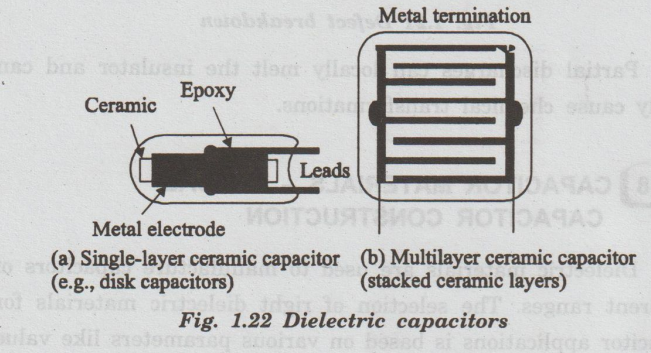
1. Single and multilayer dielectric capacitors
The
diagramatic representation of a single layer capacitor is shown in fig. 1.22.
It consists of a thin ceramic disk or plate placed in-between the metal
electrodes. The leads for the electrical connections are taken from the metal
electrode.
In
order to prevent the degradation of dielectric ceramic plate it is encapsulated
in an epoxy coating.
The
capacitance of single layer capacitor for an area of 1 cm2 is 885
pf. The capacitance of the capacitor by connecting N number of ceramic plate in
parallel by providing a sufficient space as shown in fig. 1.22(b).
The
capacitor with stacking of ceramic plates in different layers is known as
multilayer capacitor. The capacitance of multilayer capacitor is in the range
of a few hundred microfarads.
2. Polymeric film capacitors
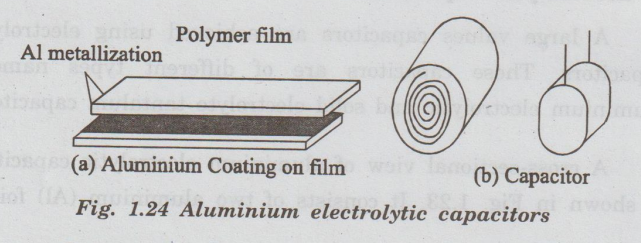
Polymer
thin film capacitors are as mid-frequency capacitors. The two metal coated
polymer films are placed in parallel. In order to get the capacitor, the two
metal sheets are rolled together like Swiss roll.
The
electrical connections are taken from the opposite sides of the metals by
proper soldering. A multilayer polymeric thin film capacitors like multilayer
ceramic capacitors can also be produced.
3. Electrolytic capacitors
A
large values capacitors are achieved using electrolytic capacitors. These
capacitors are of different types namely, aluminium electrolytic and solid
electrolyte tantalum capacitors.
A
cross-sectional view of aluminium electrolytic capacitors is shown in Fig.
1.23. It consists of two aluminium (Al) foils.
A
thin layer of Al2O3 as a dielectric medium is grown on
the rough surface of one of the foils. The two foils are wound together in the
form of cylinder. They kept inside the cylindrical case as shown in fig. 1.23.
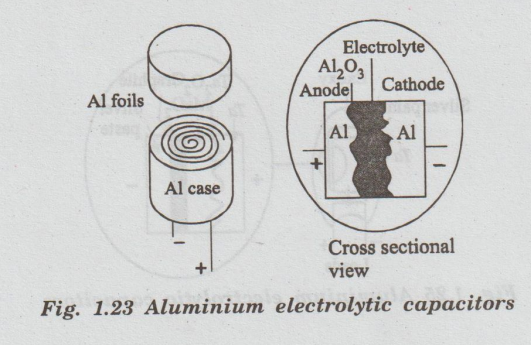
The
thickness of Al2O3, grown on the foil is 0.1 μm and hence, it gives
large capacitance value (i.e., small thickness and large area.
The Al2O3 is grown on
the Al foil electrolytically and hence, the capacitor is known as electrolytic
capacitor.
A
thin film of Al2O3 dielectric coated on the surface of Al
foil act as anode. Al foil acts as a cathode.
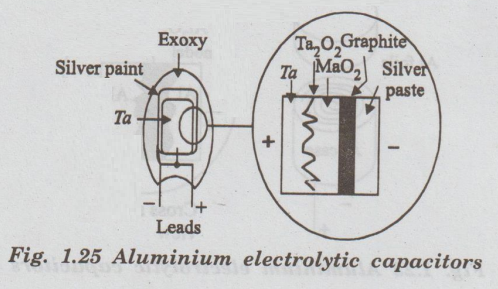
The
structure of a solid electrolyte tantalum capacitor is shown in fig. 1.24(a).
The anode is made up of tantalum (Ta) pellet. The surface of Ta pellet is
anodized to get the tantalum pentoxide (Ta2O3).
A
thick solid electrolyte like MnO2 is coated above Ta2O2.
The process is completed by coating graphite and silver paste as shown in fig.
1.25. The above system is then coated by an epoxy. Tantalum capacitors are
widely used in electronic applications.
Physics for Electrical Engineering: Unit I: Dielectric Materials and Insulation : Tag: : - Capacitor materials typical capacitor construction
Physics for Electrical Engineering: Unit I: Dielectric Materials and Insulation
Under Subject
Physics for Electrical Engineering
PH3202 2nd Semester 2021 Regulation | 2nd Semester EEE Dept 2021 Regulation
Related Subjects

Professional English II
HS3251 2nd Semester 2021 Regulation | 2nd Semester Common to all Dept 2021 Regulation
Statistics and Numerical Methods
MA3251 2nd Semester 2021 Regulation M2 Engineering Mathematics 2 | 2nd Semester Common to all Dept 2021 Regulation
Engineering Graphics
GE3251 eg 2nd semester | 2021 Regulation | 2nd Semester Common to all Dept 2021 Regulation
Physics for Electrical Engineering
PH3202 2nd Semester 2021 Regulation | 2nd Semester EEE Dept 2021 Regulation
Basic Civil and Mechanical Engineering
BE3255 2nd Semester 2021 Regulation | 2nd Semester EEE Dept 2021 Regulation
Electric Circuit Analysis
EE3251 2nd Semester 2021 Regulation | 2nd Semester EEE Dept 2021 Regulation
Physics for Electronics Engineering
PH3254 - Physics II - 2nd Semester - ECE Department - 2021 Regulation | 2nd Semester ECE Dept 2021 Regulation
Electrical and Instrumentation Engineering
BE3254 - 2nd Semester - ECE Dept - 2021 Regulation | 2nd Semester ECE Dept 2021 Regulation
Circuit Analysis
EC3251 - 2nd Semester - ECE Dept - 2021 Regulation | 2nd Semester ECE Dept 2021 Regulation
Materials Science
PH3251 2nd semester Mechanical Dept | 2021 Regulation | 2nd Semester Mechanical Dept 2021 Regulation
Basic Electrical and Electronics Engineering
BE3251 2nd semester Mechanical Dept | 2021 Regulation | 2nd Semester Mechanical Dept 2021 Regulation
Physics for Civil Engineering
PH3201 2021 Regulation | 2nd Semester Civil Dept 2021 Regulation
Basic Electrical, Electronics and Instrumentation Engineering
BE3252 2021 Regulation | 2nd Semester Civil Dept 2021 Regulation
Physics for Information Science
PH3256 2nd Semester CSE Dept | 2021 Regulation | 2nd Semester CSE Dept 2021 Regulation
Basic Electrical and Electronics Engineering
BE3251 2nd Semester CSE Dept 2021 | Regulation | 2nd Semester CSE Dept 2021 Regulation
Programming in C
CS3251 2nd Semester CSE Dept 2021 | Regulation | 2nd Semester CSE Dept 2021 Regulation