Statistics and Numerical Methods: Unit V: Numerical Solution of Ordinary Differential Equations
Fourth order runge-kutta method for solving first order equations
Solved Example Problems
The Taylor's series method of solving differential equations numerically is restricted by the work involved in finding the higher order derivatives. However, there are class methods known as Runge-Kutta methods
FOURTH ORDER RUNGE-KUTTA METHOD FOR SOLVING FIRST ORDER
EQUATIONS
The
Taylor's series method of solving differential equations numerically is
restricted by the work involved in finding the higher order derivatives.
However, there are class methods known as Runge-Kutta methods which do not
require the calculations of higher order derivatives and give greater accuracy.
These
methods have the following useful properties :
1.
To evaluate ym+1, they need only information at the point (xm, ym).
2.
They don't involve the derivatives of f (x, y), such as in Taylor's series
method.
3.
They agree with the Taylor's series solution upto the terms of hr,
where r differs from method to method and is known as the order of that
Range-Kutta method.
Since,
Euler's method and modified forms satisfy all the three properties, they can be
termed as Runge-Kutta methods of first and second order respectively.
In
these methods, the accuracy increases at the cost of calculations. Of this
family of methods, the most widely used method is Runge-Kutta of fourth order
and so the name Runge-Kutta is used generally for this method. This method
coincides with the Taylor's series solution upto terms of h4.
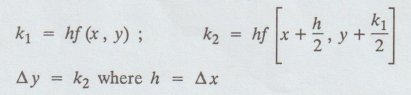
1. SECOND ORDER R-K METHOD
If
the initial values of (x, y) for the differential equationdy/dx = f(x, y) then
the first increment in y namely Ay is calculated from the formula.
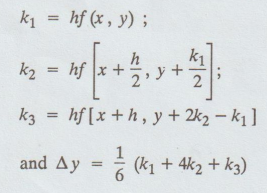
2. THIRD ORDER R-K METHOD
The
algorithm for this method is given below:
3. FOURTH ORDER R-K METHOD
The
algorithm for this method is given below :

Now,
starting from (x1, y1) and repeat the process.
Note
1:
The Runge-Kutta method of second order is nothing but the modified Euler
method.
Note
2:
One of the advantages of these methods is that the operation is identical
whether the differential equation is linear or non-linear.
1.
Use Runge-Kutta method of the fourth order to find y (0.2) and y (0.4) given
that y(dy/dx) = y2 – x, y(0) – 2 by taking h= 0.2 (upto four decimal
places)
Solution:

2.
Given dy/dx = x3 + y, y (0) = 2. Compute y (0.2), y (0.4) and y
(0.6) by Runge-Kutta method of fourth order. [A.U. A/M 2004]
Solution:

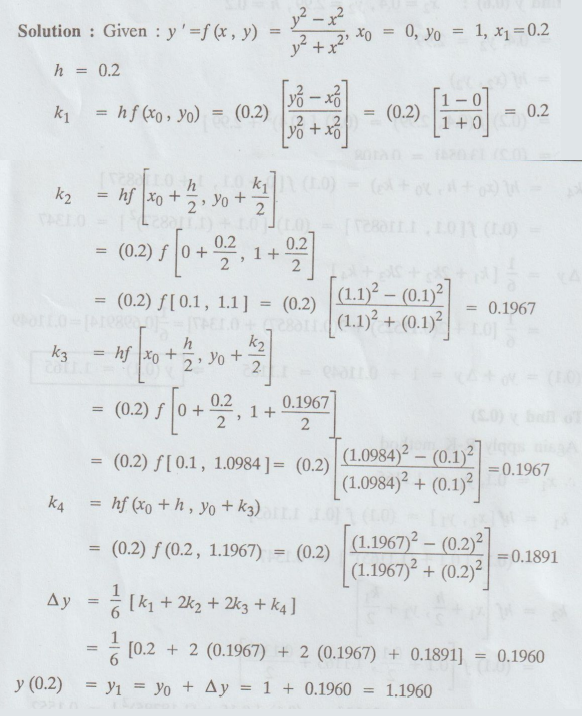
3.
Using R-K method of fourth order, solve dy/dx = y2 – x2 /
y2 + x2 with y (0)
= 1 at x = 0.2.
[A.U.
N/D 2004, 2006, 2007, 2015 (R-13), 2017 (R-8)]
[A.U
A/M 2005, 2010, 2015(R-8), 2013, 2017 (R-8)]
Solution:
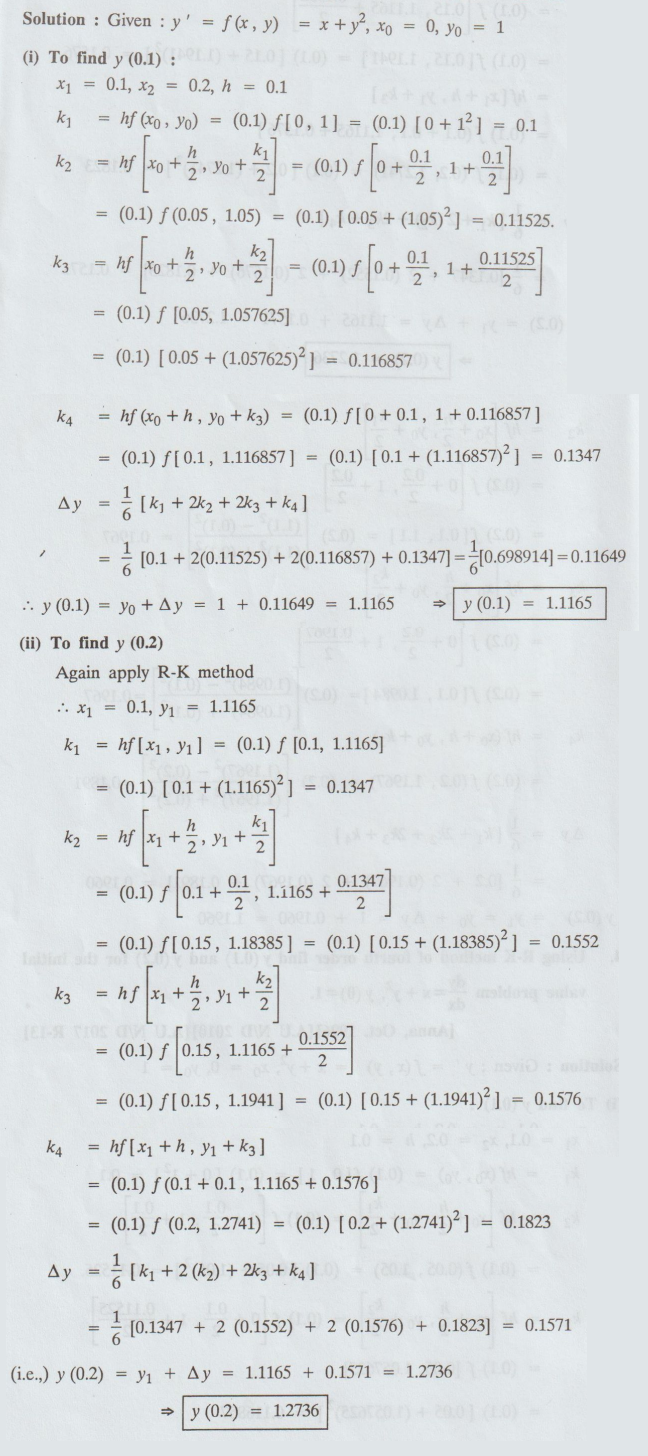
4.
Using R-K method of fourth order find y (0.1) and y (0.2) for the initial value
problem dy / dx = x + y2, y(0)=1. [Anna, Oct. 1996] [A.U N/D 2010]
[A.U N/D 2017 R-13]
Solution:
5.
Use the fourth order R-K method to compute y for x = 0.1, given y' = xy / 1 + x2,
y(0) = 1, take h= 0.1.
Solution:

6.
Find y (0.7) & y (0.8) given that y' = y − x2, y (0.6) = 1.7379
by using Runge-Kutta method of fourth order. Take h = 0.1.
[Anna,
April, 2000] [A.U M/J 2012] [A.U N/D 2016 R-13]
Solution:

7.
Apply fourth order Runge-Kutta method to determine y (0.1) and y (0.2) with h = 0.1 from dy/dx = x2
+ y2, y(0) = 1.
[A.U.
May 2000, CBT M/J 2010, A/M 2011] [A.U N/D 2019 R17]
Solution:

Statistics and Numerical Methods: Unit V: Numerical Solution of Ordinary Differential Equations : Tag: : Solved Example Problems - Fourth order runge-kutta method for solving first order equations
Statistics and Numerical Methods: Unit V: Numerical Solution of Ordinary Differential Equations
Under Subject
Statistics and Numerical Methods
MA3251 2nd Semester 2021 Regulation M2 Engineering Mathematics 2 | 2nd Semester Common to all Dept 2021 Regulation
Related Subjects

Professional English II
HS3251 2nd Semester 2021 Regulation | 2nd Semester Common to all Dept 2021 Regulation
Statistics and Numerical Methods
MA3251 2nd Semester 2021 Regulation M2 Engineering Mathematics 2 | 2nd Semester Common to all Dept 2021 Regulation

Engineering Graphics
GE3251 eg 2nd semester | 2021 Regulation | 2nd Semester Common to all Dept 2021 Regulation

Physics for Electrical Engineering
PH3202 2nd Semester 2021 Regulation | 2nd Semester EEE Dept 2021 Regulation

Basic Civil and Mechanical Engineering
BE3255 2nd Semester 2021 Regulation | 2nd Semester EEE Dept 2021 Regulation

Electric Circuit Analysis
EE3251 2nd Semester 2021 Regulation | 2nd Semester EEE Dept 2021 Regulation

Physics for Electronics Engineering
PH3254 - Physics II - 2nd Semester - ECE Department - 2021 Regulation | 2nd Semester ECE Dept 2021 Regulation

Electrical and Instrumentation Engineering
BE3254 - 2nd Semester - ECE Dept - 2021 Regulation | 2nd Semester ECE Dept 2021 Regulation
Circuit Analysis
EC3251 - 2nd Semester - ECE Dept - 2021 Regulation | 2nd Semester ECE Dept 2021 Regulation

Materials Science
PH3251 2nd semester Mechanical Dept | 2021 Regulation | 2nd Semester Mechanical Dept 2021 Regulation

Basic Electrical and Electronics Engineering
BE3251 2nd semester Mechanical Dept | 2021 Regulation | 2nd Semester Mechanical Dept 2021 Regulation

Physics for Civil Engineering
PH3201 2021 Regulation | 2nd Semester Civil Dept 2021 Regulation

Basic Electrical, Electronics and Instrumentation Engineering
BE3252 2021 Regulation | 2nd Semester Civil Dept 2021 Regulation

Physics for Information Science
PH3256 2nd Semester CSE Dept | 2021 Regulation | 2nd Semester CSE Dept 2021 Regulation

Basic Electrical and Electronics Engineering
BE3251 2nd Semester CSE Dept 2021 | Regulation | 2nd Semester CSE Dept 2021 Regulation

Programming in C
CS3251 2nd Semester CSE Dept 2021 | Regulation | 2nd Semester CSE Dept 2021 Regulation