Statistics and Numerical Methods: Unit V: Numerical Solution of Ordinary Differential Equations
Milne's predictor and corrector methods for solving first order equations
Solved Example Problems
Runge-Kutta methods are called single-step methods because they use only the information from the last step computed.
MILNE'S PREDICTOR AND CORRECTOR METHODS FOR SOLVING FIRST ORDER
EQUATIONS
Runge-Kutta
methods are called single-step methods because they use only the information
from the last step computed. The methods of Milne's predictor-corrector and
Adams-Bashforth predictor corrector formulae are multi-step methods.
In
the previous method to calculate the value of yn+1, we need only the
information at (xn, yn) and we do not care for the nature
of the solution. But, the methods of this section remove this objection. As
obvious by the name, we first predict the value of yn + 1 by some
formula, known as "predictor formula" and then recorrect this value
by another formula, called "corrector formula". The values are called
as predicted and corrected values respectively.

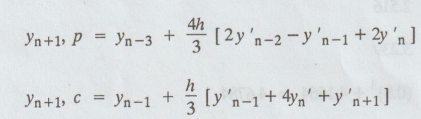
Milne's
predictor-corrector formula
Milne's
method is the most common multi-step method that first predicts a value for
yn+1 from three past values of the derivative. It differs from the Adam's
method. In that it integrates over more than one interval. The past values that
we require may have been computed by R-K method, or possibly by the Taylor's
series method. In the Milne method, we suppose that four equispaced starting
values of y are known, at the points
xn,
xn-1 , xn-2 and xn-3
Milne's
predictor and corrector formula is
1.
Given dy/dx = x3 + y, y(0) = 2. The values of y (0.2) = 2.073, y
(0.4) = 2.452, and y (0.6) = 3.023 are got by R-K method of fourth order. Find
y (0.8) by Milne's predictor-corrector method taking h = 0.2. [A.U. A/M 2004, M/J 2014] [A.U N/D 2017 R-13]
Solution:
Here,

2.
Using Milne's method find y(4.4) given
5xy + y2 – 2 = 0 given y(4) = 1, y (4.1) = 1.0049, y(4.2) = 1.0097
and y (4.3) = 1.0143.
Solution
:

3.
Solve y' = x - y2, 0 ≤ x ≤ 1, y(0) = 0, y (0.2) = 0.02, y (0.4) =
0.0795; y (0.6) = 0.1762 by Milne's method to find y (0.8) and y (1). [A.U. A/M
2005, A.U. Oct. 1996, N/D 2010]
Solution
:

4.
Using Milne's method find y (2), if y (x) is the solution of dy/dx = 1/2 (x + y) given y (0) = 2, y (0.5) = 2.636, y
(1) = 3.595 and y (1.5) = 4.968.
Solution
:

5.
Determine the value of y (0.4) using Milne's method given y' = xy + y2,
y (0) = 1; use Taylor series to get the values of y (0.1), y (0.2) and y (0.3).
[A.U M/J 2009, A/M 2015 R13, R8] [A.U
A/M 2017 R-13]
Solution:

6.
Given y' 1-y and y (0) = 0, find
(i)
y (0.1) by Euler's method.
(ii)
y (0.2) by modified Euler's method.
(iii)
y (0.4) by Milne's method.
Solution
:
By
Euler’s method,
y1
= y0 + hf (x0 , y0 ) = 0 + (0.1) (1 - y0)
= 0.1
By
modified Euler’s method:

7.
Solve: y = x2 + y2 - 2 using Milne's method for x = 0.3
given

Solution:
We
have to calculate y (0.3) by Milne's method.
Milne's
predictor formula is

8.
Using Runge-Kutta method Calculate y (0.1), y (0.2) and y (0.3) given that dy /dx
- 2xy / 1 + x2 = 1, y (0) =
0. Taking these values as starting values find y (0.4) by Milne's method.
Solution:


9.
Using Runge-Kutta method of order 4, find y for x = 0.1, 0.2, 0.3 given that dy/dx
= xy + y2, y (0) = 1 and also find the solution at x = 0.4 using Milne’s
mrthod.
[A.U. N/D 2003] [A.U M/J 2006, Tvli M/J 2010,
N/D 2010, A/M 2011, N/D 2014] L.) ([A.U N/D 2019 R-13]
Solution:
Given:
y' = xy + y2
By
using R.K. Algorithm.
(i)
To find y (0.1): Here x0 = U, y0 = 1,
h = 0.1


10.
Use Milne's predictor-corrector formula to find y (0.4), given
dy/dx
= (1+x2)y2 / 2, y
(0) = 1, y (0.1) = 1.06, y (0.2) 1.12 and y (0.3) = 1.21
[A.U A/M 2010, N/D 2011] [A.U. N/D 2020 R-17,
A/M 2021 R-17]
Solution
:

11.
Given y = 1/x+y, y(0) = 2, y (0.2) = 2.0933, y (0.4) = 2.1755, y (0.6) = 2.2493,
y (0.8) by Milne's predictor corrector ethod. [AU Tvli M/J 2010] [A.U M/J 2012]
[A.U N/D 2021 R-17]
Solution
:

12.
Given dy/dx = x2 (1 + y) and
y(1) = 1, y(1.1) = 1.233, y (1.2) = 1.548, y (1.3)= 1.979, evaluate y (1.4) by
using Milne's method. [A.U N/D 2019 (R17)]
Solution
:
Given:
y' = x2 (1+y) … (1)
Here,
h = 0.1

Statistics and Numerical Methods: Unit V: Numerical Solution of Ordinary Differential Equations : Tag: : Solved Example Problems - Milne's predictor and corrector methods for solving first order equations
Statistics and Numerical Methods: Unit V: Numerical Solution of Ordinary Differential Equations
Under Subject
Statistics and Numerical Methods
MA3251 2nd Semester 2021 Regulation M2 Engineering Mathematics 2 | 2nd Semester Common to all Dept 2021 Regulation
Related Subjects

Professional English II
HS3251 2nd Semester 2021 Regulation | 2nd Semester Common to all Dept 2021 Regulation
Statistics and Numerical Methods
MA3251 2nd Semester 2021 Regulation M2 Engineering Mathematics 2 | 2nd Semester Common to all Dept 2021 Regulation

Engineering Graphics
GE3251 eg 2nd semester | 2021 Regulation | 2nd Semester Common to all Dept 2021 Regulation

Physics for Electrical Engineering
PH3202 2nd Semester 2021 Regulation | 2nd Semester EEE Dept 2021 Regulation

Basic Civil and Mechanical Engineering
BE3255 2nd Semester 2021 Regulation | 2nd Semester EEE Dept 2021 Regulation
Electric Circuit Analysis
EE3251 2nd Semester 2021 Regulation | 2nd Semester EEE Dept 2021 Regulation

Physics for Electronics Engineering
PH3254 - Physics II - 2nd Semester - ECE Department - 2021 Regulation | 2nd Semester ECE Dept 2021 Regulation

Electrical and Instrumentation Engineering
BE3254 - 2nd Semester - ECE Dept - 2021 Regulation | 2nd Semester ECE Dept 2021 Regulation
Circuit Analysis
EC3251 - 2nd Semester - ECE Dept - 2021 Regulation | 2nd Semester ECE Dept 2021 Regulation

Materials Science
PH3251 2nd semester Mechanical Dept | 2021 Regulation | 2nd Semester Mechanical Dept 2021 Regulation

Basic Electrical and Electronics Engineering
BE3251 2nd semester Mechanical Dept | 2021 Regulation | 2nd Semester Mechanical Dept 2021 Regulation

Physics for Civil Engineering
PH3201 2021 Regulation | 2nd Semester Civil Dept 2021 Regulation

Basic Electrical, Electronics and Instrumentation Engineering
BE3252 2021 Regulation | 2nd Semester Civil Dept 2021 Regulation

Physics for Information Science
PH3256 2nd Semester CSE Dept | 2021 Regulation | 2nd Semester CSE Dept 2021 Regulation

Basic Electrical and Electronics Engineering
BE3251 2nd Semester CSE Dept 2021 | Regulation | 2nd Semester CSE Dept 2021 Regulation

Programming in C
CS3251 2nd Semester CSE Dept 2021 | Regulation | 2nd Semester CSE Dept 2021 Regulation