Statistics and Numerical Methods: Unit V: Numerical Solution of Ordinary Differential Equations
Taylor's series method
Solved Example Problems
The method gives a straightforward adaptation of classic calculus to develop the solution as an infinite series. It is a powerful single step method, if we are able to find the successive derivatives easily.
UNIT - V
NUMERICAL SOLUTION OF ORDINARY DIFFERENTIAL
EQUATIONS
TAYLOR'S SERIES METHOD
The
method gives a straightforward adaptation of classic calculus to develop the
solution as an infinite series. It is a powerful single step method, if we are
able to find the successive derivatives easily. If f (x, y) involves some
complicated algebraic structures, then the calculation of higher derivatives
become tedious and the method fails. This is the major drawback of this method.
However, the method will be very useful for finding the starting values for
powerful methods like Runge-Kutta method, Milne's method etc.
Consider
the first order differential equation
dy
/ dx = f(x, y) …. (1)
with
y (xo) = y0
Differentiating
(1) with respect to x, we get
d2y
/ dx2 = ∂f / ∂x + ∂f / ∂y dy / dx …. (2)
Differentiating
this successively, we can obtain y ''', yiv, ...
putting
x = x0 and y = 0, the values of y0', y0'' ...
can be obtained.
Hence,
the Taylor's series expansion of y (x) at x = xo is given by

gives
the values of y for every value of x for which (3) converges. Let x1
= x0 + h and let

Once
y1 is known, we can compute y1 , y1 …. from
(1), (2) etc.
Then,
y can be expanded in a Taylor's series about x = x1 and we have

continuing
in this way, we find the solution y (x).
1.
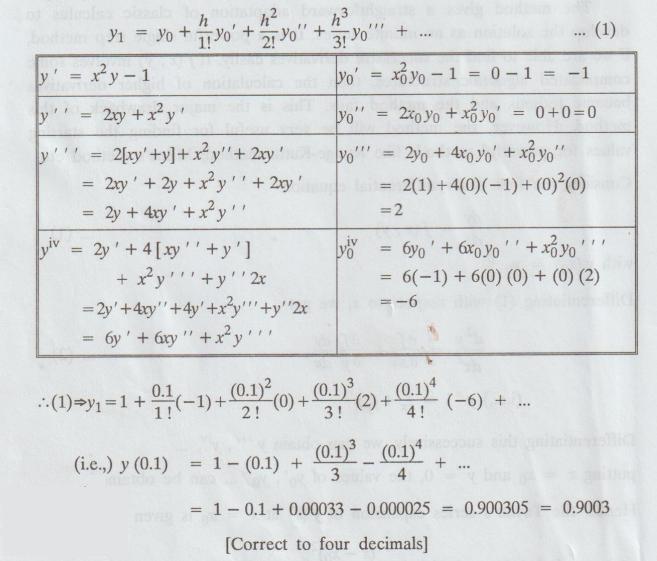
Using Taylor's series method find y at x = 0.1 if dy / dx = x2y - 1,
y
(0) = 1. [A.U. N/D 2004, N/D 2010, N/D
2014 NM]
Solution:
Given
y' = x2y - 1 and x0 = 0, y0 = 1, h = 0.1
By
Taylor's series formula for y1 is
2.
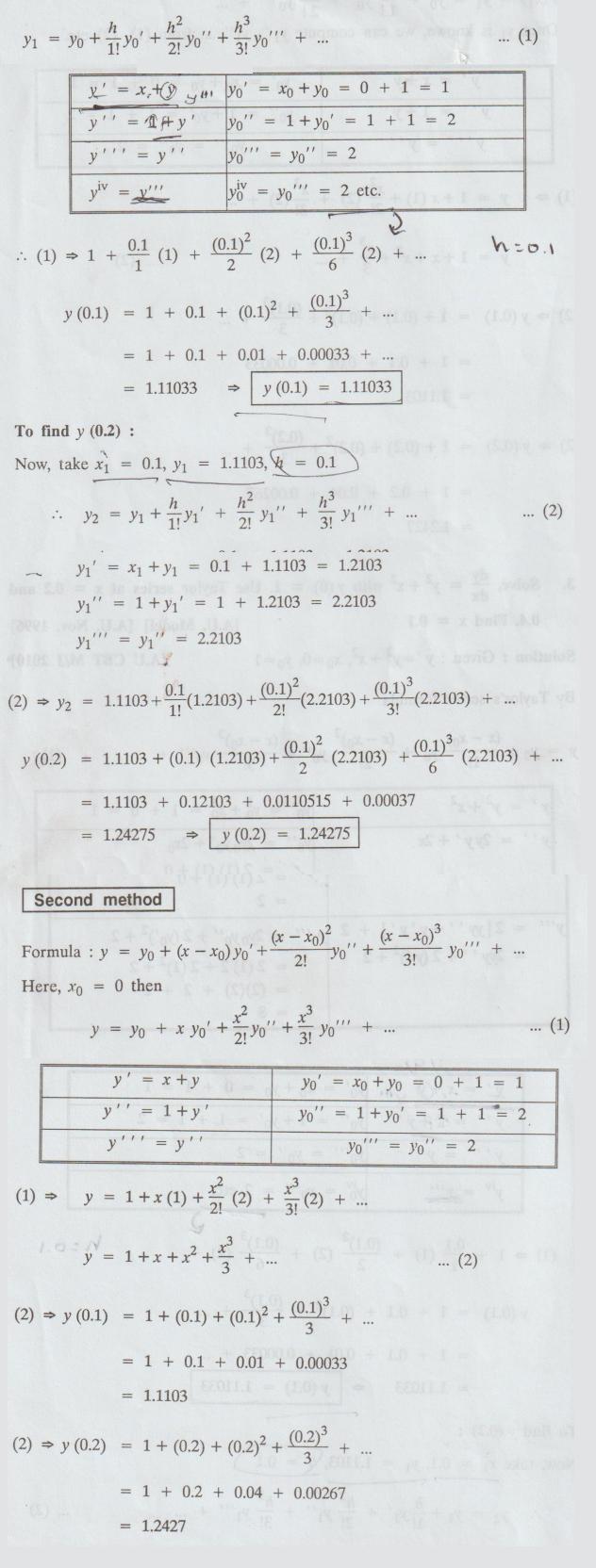
Solve, y' = x+y; y (0) = 1, by Taylor's series method. Find the values y at x =
0.1 and x = 0.2.
[A.U.
A/M 2005] [A.U CBT M/J 2010]TA.U M/J 2013, M/J 2014] [A.U N/D 2019 R-13]
Solution
:
To
find
y (0.1) : Given y = x + y and x0 = 0, y0 = 1 h = 0.1
We
know that, the Taylor's series formula for y1 is
3.
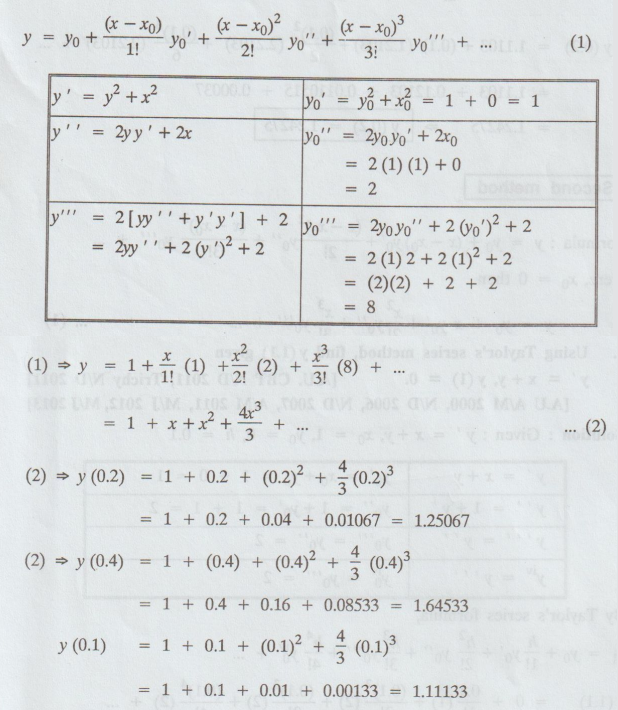
Solve dy / dx = y2 + x2 with y (0) = 1. Use Taylor series
at x = 0.2 and 0.4. Find x = 0.1
Solution:
Given:
y2 = y2 + x2, x0 =
0, y0 =1
By
Taylor's series formula
4.
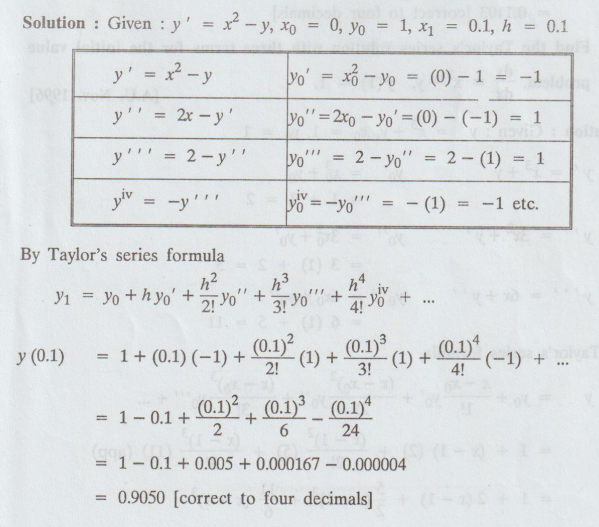
Using Taylor's series method find y at x = 0.1 correct to four decimal places
from dy / dx = x2 - y, y (0) = 1, with h = 0.1. Compute terms upto x4
[A.U. May 2000, Trichy A/M 2010] [A.U M/J
2012] [A.U N/D 2016 R-13] [A.U N/D 2017 R-13]
Solution:
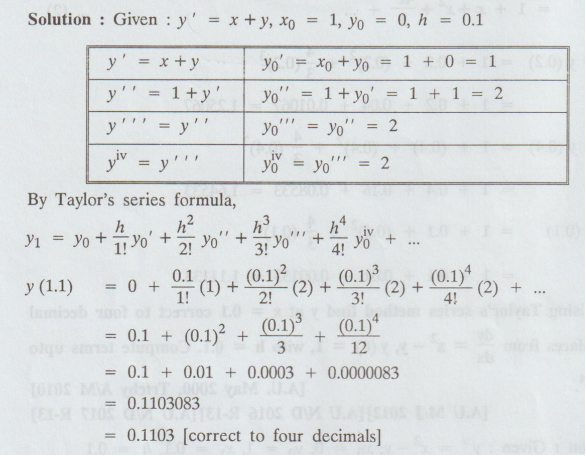
5.
Using Taylor's series method, find y (1.1) given
y'
= x + y, y (1) = 0.
[A.U.
CBT N/D 2011, Trichy N/D 2011]
[A.U
A/M 2000, N/D 2006, N/D 2007, A/M 2011, M/J 2012, M/J 2013]
Solution:
Given:
y = x + y, x0 = 1, y0
= 0, h = 0.1
6.
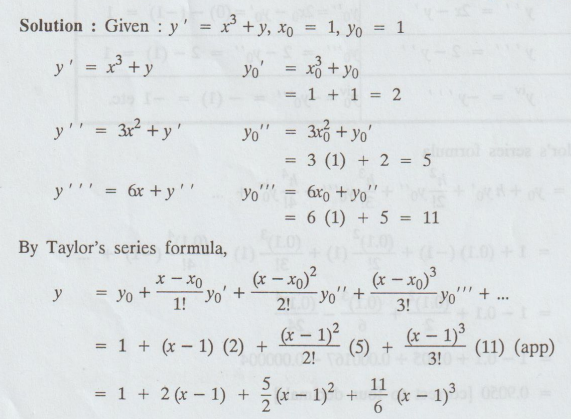
Find the Taylor's series solution with three terms for the initial value problem.
dy/dx = x3 + y, y (1) = 1.
Solution:
7.
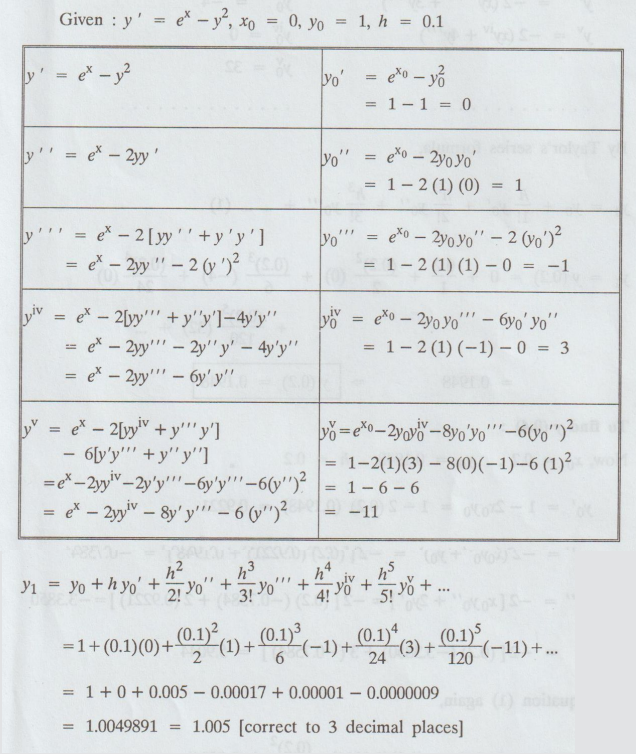
Using Taylor's series method with the first five terms in the expansion find y
(0.1) correct to three decimal places, given that dy / dx = ex – y2,
dy (0) = 1.
[A.U. May, 1996]
Solution
:
8.
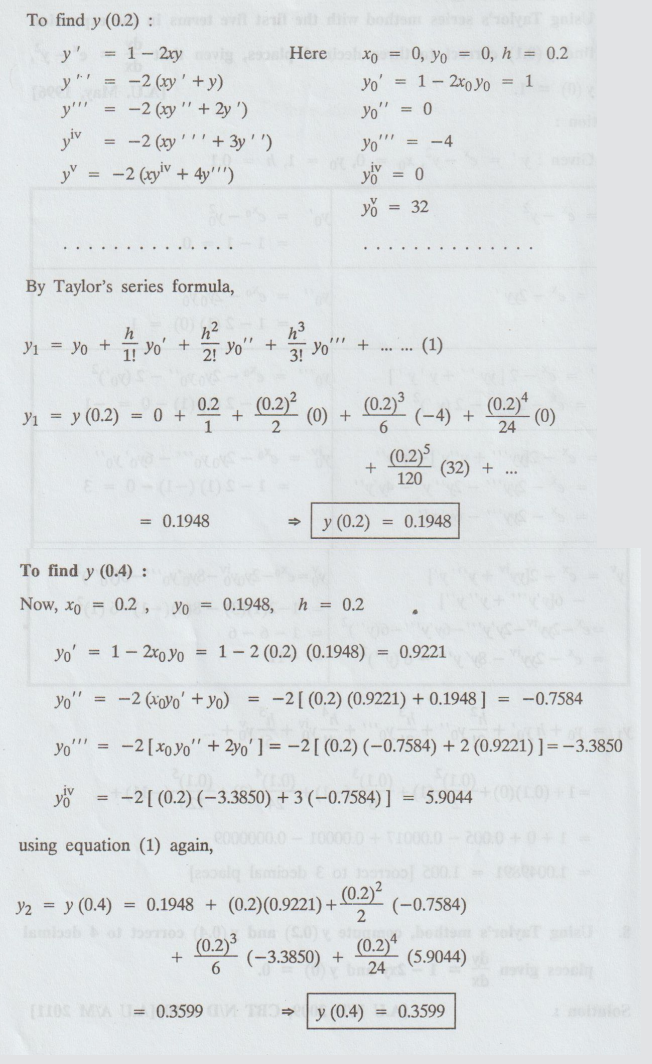
Using Taylor's method, compute y (0.2) and y (0.4) correct to 4 decimal places
given dy/dx = 1 - 2xy and y (0) = 0. [A.U N/D 2009, CBT N/D 2010] [A.U A/M
2011]
Solution
:
9.
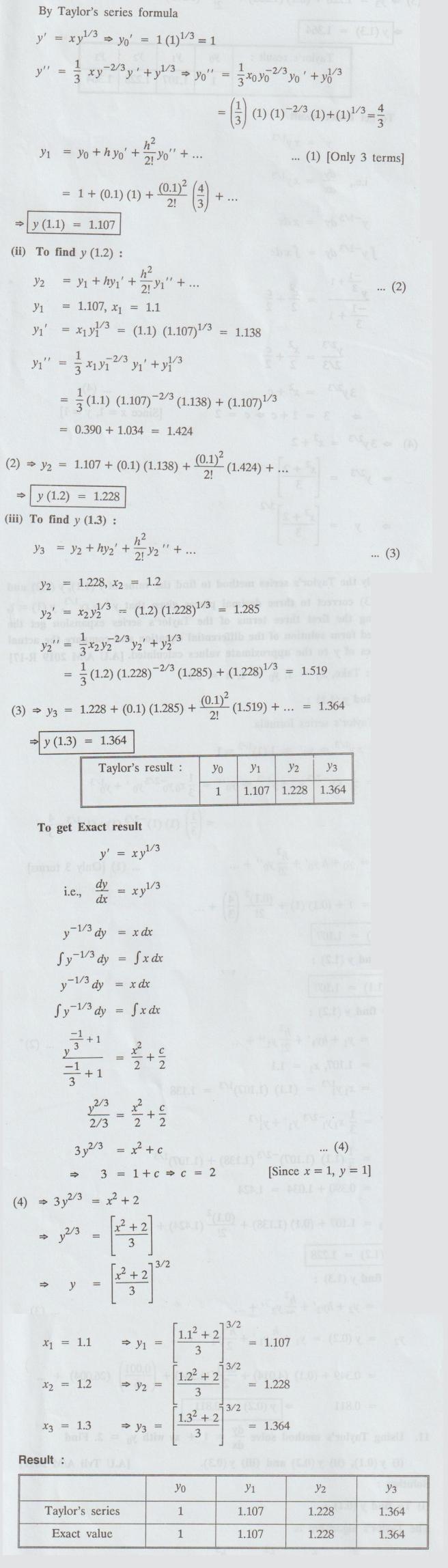
Apply the Taylor's series method to find the value of y (1.1), y (1.2) and y
(1.3) correct to three decimal places given that y' = xy1/3, y (1) =
1, taking the first three terms of the Taylor's series expansion get the closed
form solution of the differential equation and compare the actual values of y
to the approximate values calculated. [A.U A/M 2019 R-17]
Solution:
Take, x0 = 1, y0 = 1, h = 0.1
(i)
To find y (1.1):
10.
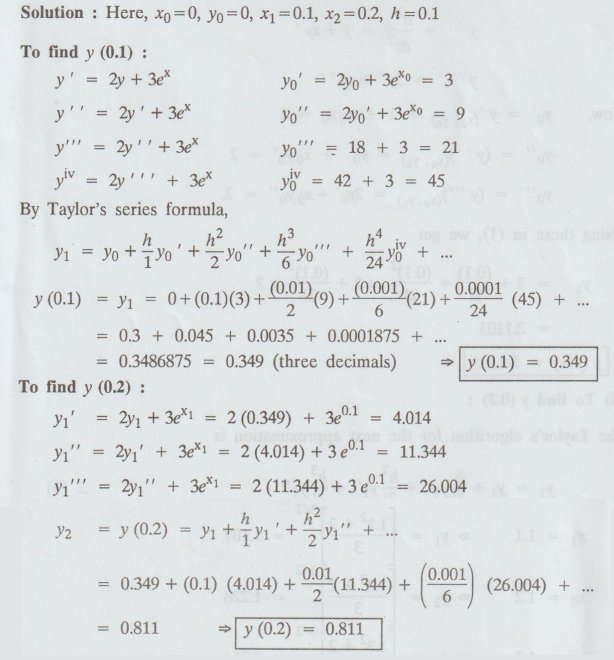
By means of Taylor's series expansion, find y at x = 0.1, 0.2 correct to three
significant digits given dy / dx - 2y = 3ex, y (0)=0.
[A.U
N/D 2006, A/M 2010, CBT N/D 2011] [A.U N/D 2014] [A.U A/M 2015 R-13] [A.U N/D
2019 R-13] [A.U N/D 2021 (R-17)]
Solution:
Here,
x0 = 0, y0 = 0, x1 = 0.1, x2 = 0.2,
h = 0.1
To
find y (0.1):
11.
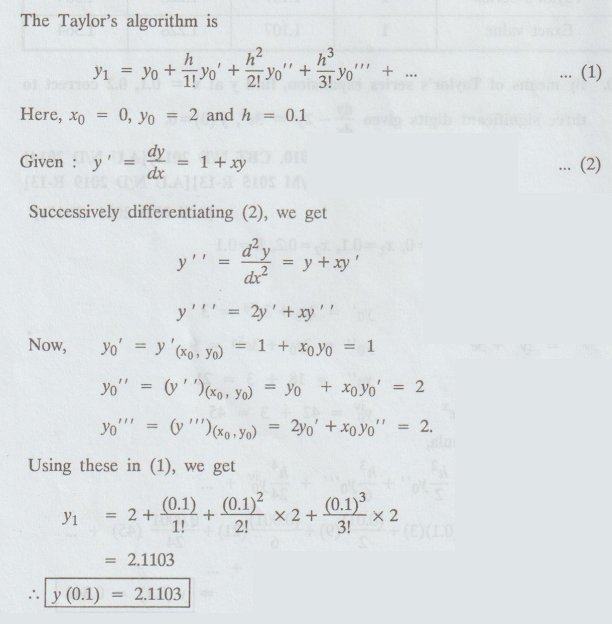
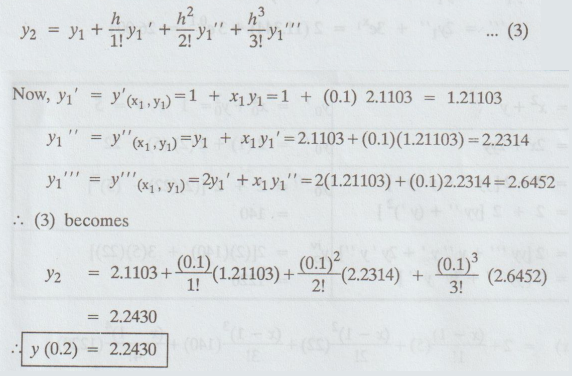
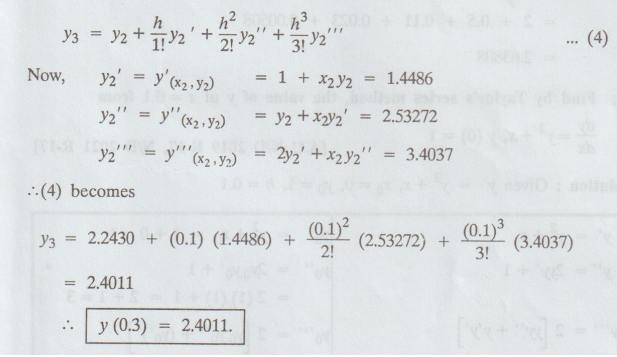
Using Taylor's method solve dy/dx = 1 + xy with y0 = 2. Find
(i)
y (0.1), (ii) y (0.2) and (iii) y (0.3). [A.U Tvli A/M 2011]
Solution
:
(i) To find y (0.1):
The
Taylor's algorithm is
(ii)
To find y (0.2):
The
Taylor's algorithm for the next approximation is
(iii) To find y (0.3):
The
Taylor's algorithm for third approximation is
12.
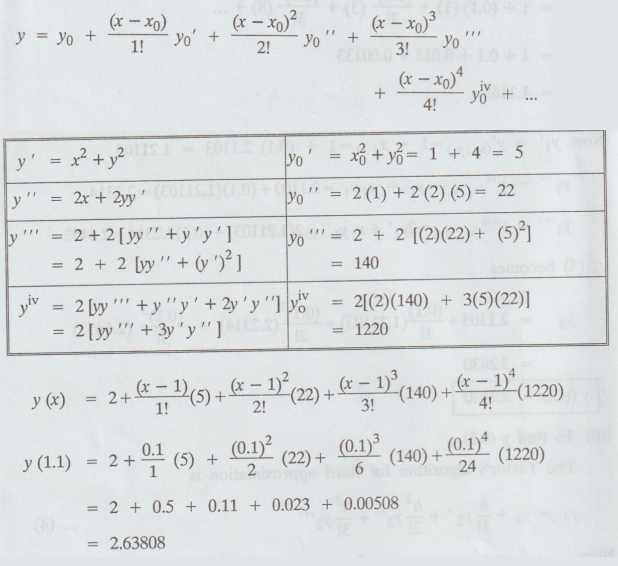
Using Taylor's series method, find y at x = 1.1 by solving the equation dy / dx
x2 + y2; y (1) = 2. Carry out the computations upto
fourth order derivative. [A.U M/J 2014 R8 (NM)]
[A.U
N/D 2020 R-17, A/M 2021 R-17]
Solution:
y'
= x2 + y2, x0 = 1, y0 = 2
By
Taylor's series formula
13.
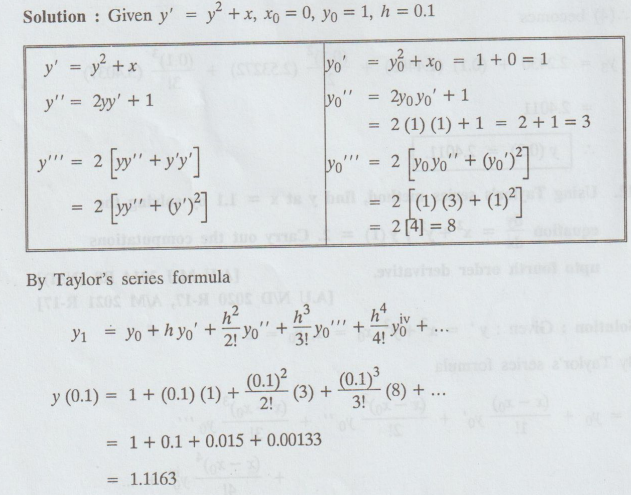
Find by Taylor's series method, the value of y at x = 0.1 from
dy/dx
= y2 + x, y (0) = 1
[A.U N/D 2019 R-17, N/D 2021 R-17]
Solution
:
Given
y' = y2 + x, x0 = 0, y0 = 1, h = 0.1
Statistics and Numerical Methods: Unit V: Numerical Solution of Ordinary Differential Equations : Tag: : Solved Example Problems - Taylor's series method
Statistics and Numerical Methods: Unit V: Numerical Solution of Ordinary Differential Equations
Under Subject
Statistics and Numerical Methods
MA3251 2nd Semester 2021 Regulation M2 Engineering Mathematics 2 | 2nd Semester Common to all Dept 2021 Regulation
Related Subjects

Professional English II
HS3251 2nd Semester 2021 Regulation | 2nd Semester Common to all Dept 2021 Regulation
Statistics and Numerical Methods
MA3251 2nd Semester 2021 Regulation M2 Engineering Mathematics 2 | 2nd Semester Common to all Dept 2021 Regulation

Engineering Graphics
GE3251 eg 2nd semester | 2021 Regulation | 2nd Semester Common to all Dept 2021 Regulation

Physics for Electrical Engineering
PH3202 2nd Semester 2021 Regulation | 2nd Semester EEE Dept 2021 Regulation

Basic Civil and Mechanical Engineering
BE3255 2nd Semester 2021 Regulation | 2nd Semester EEE Dept 2021 Regulation
Electric Circuit Analysis
EE3251 2nd Semester 2021 Regulation | 2nd Semester EEE Dept 2021 Regulation

Physics for Electronics Engineering
PH3254 - Physics II - 2nd Semester - ECE Department - 2021 Regulation | 2nd Semester ECE Dept 2021 Regulation

Electrical and Instrumentation Engineering
BE3254 - 2nd Semester - ECE Dept - 2021 Regulation | 2nd Semester ECE Dept 2021 Regulation
Circuit Analysis
EC3251 - 2nd Semester - ECE Dept - 2021 Regulation | 2nd Semester ECE Dept 2021 Regulation

Materials Science
PH3251 2nd semester Mechanical Dept | 2021 Regulation | 2nd Semester Mechanical Dept 2021 Regulation

Basic Electrical and Electronics Engineering
BE3251 2nd semester Mechanical Dept | 2021 Regulation | 2nd Semester Mechanical Dept 2021 Regulation

Physics for Civil Engineering
PH3201 2021 Regulation | 2nd Semester Civil Dept 2021 Regulation

Basic Electrical, Electronics and Instrumentation Engineering
BE3252 2021 Regulation | 2nd Semester Civil Dept 2021 Regulation

Physics for Information Science
PH3256 2nd Semester CSE Dept | 2021 Regulation | 2nd Semester CSE Dept 2021 Regulation

Basic Electrical and Electronics Engineering
BE3251 2nd Semester CSE Dept 2021 | Regulation | 2nd Semester CSE Dept 2021 Regulation
Programming in C
CS3251 2nd Semester CSE Dept 2021 | Regulation | 2nd Semester CSE Dept 2021 Regulation