Statistics and Numerical Methods: Unit V: Numerical Solution of Ordinary Differential Equations
Short Questions and Answers
Taylors Series Method
Statistics and Numerical Methods : Unit - V : Numerical solution of ordinary differential Equations : Short Questions and Answers
SHORT QUESTIONS AND ANSWERS
1.
State the disadvantage of Taylor's series method. [M.U. Oct.96]
[A.U
CBT A/M 2011] [A.U M/J 2012, M/J 2014]
Solution:
In
the differential equation dy/dx = f(x, y), the function f(x, y) may have a
complicated algebraical structure. Then, the evaluation of higher order
derivatives may become tedious. This is the demerit of this method.
2.
Write down the fourth order Taylor's Algorithm.
Solution:
ym + 1 = ym + hym’ + h2 / 2! ym''' + h4 / 4!
yivm
Here,
ynm denotes the nth derivative of y w.r.to x
at the point ym (xm, ym).
3.
Write the merits and demerits of the Taylor method of solution. [M.U. Oct. 96]
[A.U N/D 2006, A.U. Tvli N/D 2010]
Solution:
The
method gives a straight forward adoptation of classic calculus to develop the
solution as an infinite series. It is a powerful single step method, if we are
able to find the successive derivatives easily. If f(x, y) involves some
complicated algebraic structures, then the calculation of higher derivatives
becomes tedious and the method fails. This is the major drawback of this
method. However, the method will be very useful for finding the starting values
for powerful methods like Runge-Kutta method, Milne's method etc.
4.
Which is better Taylor's method or R-K Method? [M.U. Oct. 95]
Solution
:
R-K
method does not require prior calculation of higher derivatives of y (x), as
the Taylor's method does. Since, the differential equations using in
applications are often complicated, the calculation of derivatives may be
difficult.
Also,
the R-K formulas involve the computation of f (x, y) at various positions,
instead of derivatives and this function occurs in the given equation.
5.
Taylor's series method will be very useful to give some ……. for powerful
numerical methods such as Runge-Kutta method, Milne's method etc.
Solution
:
Initial starting values.
6.
State Taylor's series algorithm for the first order differential equation. [A.U
N/D 2017 R-8]
Solution
:
To
find the numerical solution of dy/dx = f(x, y) with the
condition
y (x0) = y0 We expand y(x) at a general point xm
in a Taylor series, getting ym + 1= ym + h/y!m + h2 / 2! y
m’’ + h3 / 3! y m ‘’’ + …
Here,
yrm denotes the r th derivatives of y w.r.to x at the
point (xm, ym).
7.
What is the truncation error of Taylor's series method? [A.U. Tvli M/J 2010]
Solution
:

8.
In solving dy/dx = f(x,y), y (x0) = y0, write down Taylor
series for y(x1).
[A.U
CBT N/D 2010]
Solution
:

9.
Write Taylor's formula to solve y' = f (x, y), with y (x0) = y0
[A.U. M/J 2007]
Solution:

10.
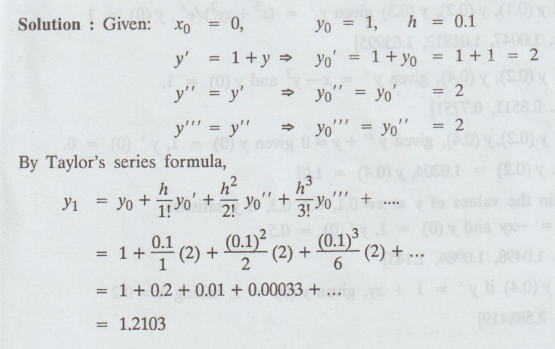
Find y (0.1) if dy/dx = 1+y, y (0) = 1, using Taylor's series method.
Solution:
11.
What are the various methods of solving ordinary differential equations?
[A.U A/M 2019 R-17] [A.U N/D 2020 R-17] [A.U
A/M 2021 R-17]
Solution
:
1.
Taylor's series method
2.
Euler's method
3.
Modified Euler's method
4.
R-K method
5.
Milne's Predictor Corrector method
6.
Adam's Predictor Corrector method
Statistics and Numerical Methods: Unit V: Numerical Solution of Ordinary Differential Equations : Tag: : Taylors Series Method - Short Questions and Answers
Statistics and Numerical Methods: Unit V: Numerical Solution of Ordinary Differential Equations
Under Subject
Statistics and Numerical Methods
MA3251 2nd Semester 2021 Regulation M2 Engineering Mathematics 2 | 2nd Semester Common to all Dept 2021 Regulation
Related Subjects

Professional English II
HS3251 2nd Semester 2021 Regulation | 2nd Semester Common to all Dept 2021 Regulation
Statistics and Numerical Methods
MA3251 2nd Semester 2021 Regulation M2 Engineering Mathematics 2 | 2nd Semester Common to all Dept 2021 Regulation
Engineering Graphics
GE3251 eg 2nd semester | 2021 Regulation | 2nd Semester Common to all Dept 2021 Regulation

Physics for Electrical Engineering
PH3202 2nd Semester 2021 Regulation | 2nd Semester EEE Dept 2021 Regulation

Basic Civil and Mechanical Engineering
BE3255 2nd Semester 2021 Regulation | 2nd Semester EEE Dept 2021 Regulation
Electric Circuit Analysis
EE3251 2nd Semester 2021 Regulation | 2nd Semester EEE Dept 2021 Regulation

Physics for Electronics Engineering
PH3254 - Physics II - 2nd Semester - ECE Department - 2021 Regulation | 2nd Semester ECE Dept 2021 Regulation

Electrical and Instrumentation Engineering
BE3254 - 2nd Semester - ECE Dept - 2021 Regulation | 2nd Semester ECE Dept 2021 Regulation
Circuit Analysis
EC3251 - 2nd Semester - ECE Dept - 2021 Regulation | 2nd Semester ECE Dept 2021 Regulation

Materials Science
PH3251 2nd semester Mechanical Dept | 2021 Regulation | 2nd Semester Mechanical Dept 2021 Regulation

Basic Electrical and Electronics Engineering
BE3251 2nd semester Mechanical Dept | 2021 Regulation | 2nd Semester Mechanical Dept 2021 Regulation

Physics for Civil Engineering
PH3201 2021 Regulation | 2nd Semester Civil Dept 2021 Regulation

Basic Electrical, Electronics and Instrumentation Engineering
BE3252 2021 Regulation | 2nd Semester Civil Dept 2021 Regulation

Physics for Information Science
PH3256 2nd Semester CSE Dept | 2021 Regulation | 2nd Semester CSE Dept 2021 Regulation

Basic Electrical and Electronics Engineering
BE3251 2nd Semester CSE Dept 2021 | Regulation | 2nd Semester CSE Dept 2021 Regulation
Programming in C
CS3251 2nd Semester CSE Dept 2021 | Regulation | 2nd Semester CSE Dept 2021 Regulation