Electric Circuit Analysis: Unit I: a. Introduction
Grouping of capacitors
in series and parallel
The capacitors of different capacitances rated vat different voltages are available in the market. To obtain the required value, the capacitors may be connected in parallel (for large value), in series (for smaller value) or in series - parallel grouping.
GROUPING
OF CAPACITORS
The
capacitors of different capacitances rated vat different voltages are available
in the market. To obtain the required value, the capacitors may be connected in
parallel (for large value), in series (for smaller value) or in series - parallel
grouping.
Case
1: Capacitors in series
Let
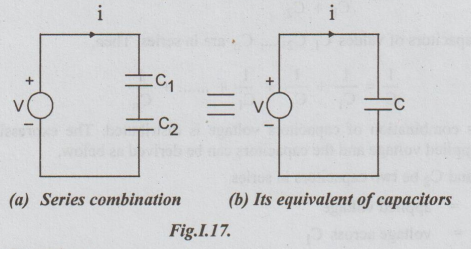
C1and C2 be two linear time variant capacitors in series
as shown in the fig. The applied voltage will be equal to the sum of the
voltages across C1 and C2, according to KVL.
Note:
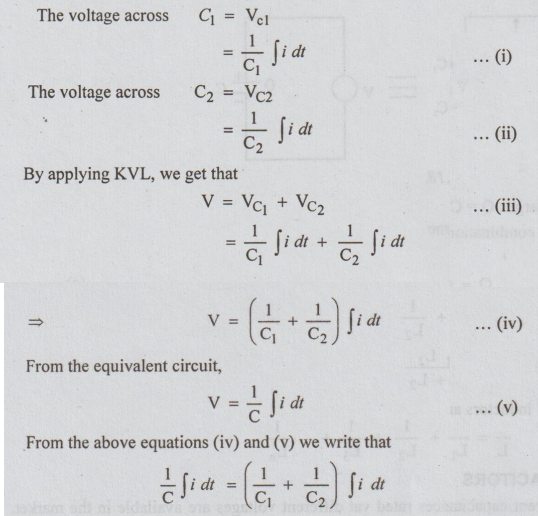
By definition of capacitance,
q
= Cv
But,
i = dq /dt = C dv/dt
V
= 1/C [ i dt]
After
cancelling ∫ i dt on both sides, we get
1/C
=1/C1 +1/C2
C
= C1C2 / C1+C2
Note:
If 'n' capacitors of values C1, C2, .... Cn
are in series. Then,
1/C
= 1/C1 +1/C1 + 1/C1+ .....+1/Cn
In
series combination of capacitors voltage is distributed. The expression for the
voltages, in terms of the applied voltage and the capacitors can be derived as
below.
Let
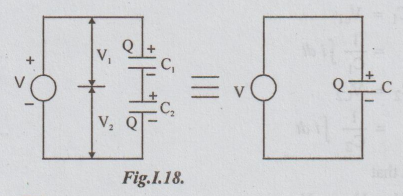
C1 and C2 be two capacitors in series
V
= applied voltage
V1=
voltage across C1
V2
= voltage across C2
Q
= Charge across C1 as well as C2 (for a series
combination charge across each capacitor is same)
Charge
Q = CV
From
series combination, Charge is the same
i,e.,
Q
= C1 V1 = C2 V2..... (a)
V2
= V1 V2 / C2 .... (b)
But V1+V2 = V ....(c)
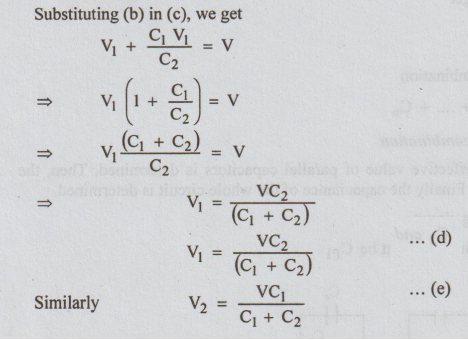
Substituting
(b) in (c), we get
Case
2: Capacitors in parallel
Consider
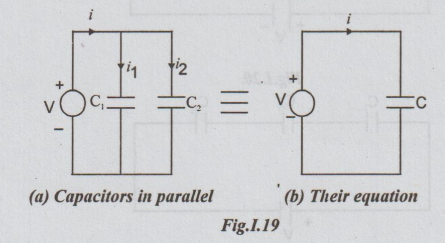
two capacitors having capacitors C1 and C2 in parallel as
shown in the fig. Assume that all the initial conditions in the capacitors are
zero.
In
the parallel combination, voltage across each capacitor will be same.
We
know that,
i
= 1i + i2 ............(a)
But
i = C dv / dt , i1 = C1 dv /dt
And
i = C2 dv / dt
Substituting
these values in (a), we get,
C
dv/dt = C1 dv / dt + C2 dv /dt
⇒ c dv/dt = (C1
+ C2) dv / dt
After
cancelling dv / dt on both sides, we get
C
= C1+ C2
Note:
Capacitors in series - parallel combination
C
= C1+ C2+ C3 + ... + Cn
Case
3: Capacitors in series - parallel combination
In
this type of circuits, first the effective value of parallel capacitors is
determined. Then, the circuit is reduced to series combination. Finally the
capacitance of the whole circuit is determined.
As
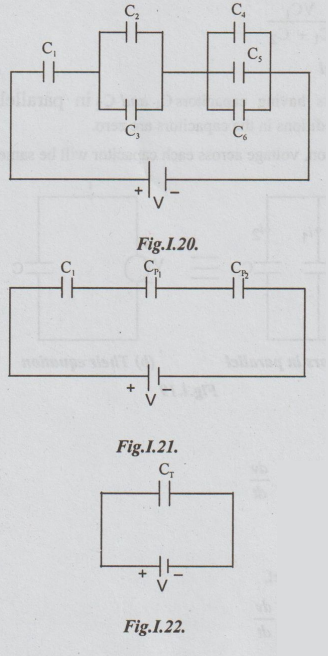
example, consider the following circuit.
C2
and C3 are in parallel. Let their equivalent be Cpl
Then,
CPI = C2+ C3
C4,
C5, C6 are in parallel. Let their equivalent be Cp2
Then,
Cp2 = C4+ C5+ C6
Now
C1,Cp1 and Cp2 are in series. Let the
equivalent capacitance be CT
1
/ CT = 1/C1 + 1/ CP1 + 1/CP3
From
the above equation we can calculate CT
Note: If another capacitor of capacitance C7 is connected across the supply in the given figure, then, finally we will get two capacitance in parallel. Then, the equivalent capacitance will be their sum.
Electric Circuit Analysis: Unit I: a. Introduction : Tag: : in series and parallel - Grouping of capacitors
Electric Circuit Analysis: Unit I: a. Introduction
Under Subject
Electric Circuit Analysis
EE3251 2nd Semester 2021 Regulation | 2nd Semester EEE Dept 2021 Regulation
Circuits and Network Analysis
EC25C02 2nd Semester ECE Dept | 2025 Regulation | 2nd Semester 2025 Regulation
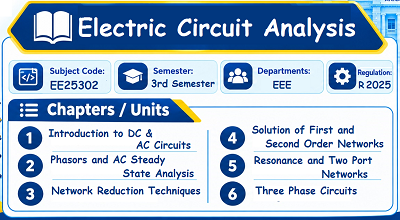
Electric Circuit Analysis
EE25302 3rd Semester EEE Dept | 2025 Regulation | 3rd Semester 2025 Regulation
Related Subjects

Professional English II
HS3251 2nd Semester 2021 Regulation | 2nd Semester Common to all Dept 2021 Regulation
Statistics and Numerical Methods
MA3251 2nd Semester 2021 Regulation M2 Engineering Mathematics 2 | 2nd Semester Common to all Dept 2021 Regulation
Engineering Graphics
GE3251 eg 2nd semester | 2021 Regulation | 2nd Semester Common to all Dept 2021 Regulation
Physics for Electrical Engineering
PH3202 2nd Semester 2021 Regulation | 2nd Semester EEE Dept 2021 Regulation
Basic Civil and Mechanical Engineering
BE3255 2nd Semester 2021 Regulation | 2nd Semester EEE Dept 2021 Regulation
Electric Circuit Analysis
EE3251 2nd Semester 2021 Regulation | 2nd Semester EEE Dept 2021 Regulation
Physics for Electronics Engineering
PH3254 - Physics II - 2nd Semester - ECE Department - 2021 Regulation | 2nd Semester ECE Dept 2021 Regulation
Electrical and Instrumentation Engineering
BE3254 - 2nd Semester - ECE Dept - 2021 Regulation | 2nd Semester ECE Dept 2021 Regulation
Circuit Analysis
EC3251 - 2nd Semester - ECE Dept - 2021 Regulation | 2nd Semester ECE Dept 2021 Regulation

Materials Science
PH3251 2nd semester Mechanical Dept | 2021 Regulation | 2nd Semester Mechanical Dept 2021 Regulation
Basic Electrical and Electronics Engineering
BE3251 2nd semester Mechanical Dept | 2021 Regulation | 2nd Semester Mechanical Dept 2021 Regulation
Physics for Civil Engineering
PH3201 2021 Regulation | 2nd Semester Civil Dept 2021 Regulation
Basic Electrical, Electronics and Instrumentation Engineering
BE3252 2021 Regulation | 2nd Semester Civil Dept 2021 Regulation

Physics for Information Science
PH3256 2nd Semester CSE Dept | 2021 Regulation | 2nd Semester CSE Dept 2021 Regulation
Basic Electrical and Electronics Engineering
BE3251 2nd Semester CSE Dept 2021 | Regulation | 2nd Semester CSE Dept 2021 Regulation
Programming in C
CS3251 2nd Semester CSE Dept 2021 | Regulation | 2nd Semester CSE Dept 2021 Regulation