Electric Circuit Analysis: Unit I: a. Introduction
Independent and dependent sources
Electric Circuit Analysis
The ideal sources discussed above are independent sources. They are also termed as uncontrolled sources. Their voltages and currents are not affected by other parts of the circuit. Their voltages and currents are fixed.
INDEPENDENT
AND DEPENDENT SOURCES:
The
ideal sources discussed above are independent sources. They are also termed as
uncontrolled sources. Their voltages and currents are not affected by other
parts of the circuit. Their voltages and currents are fixed.
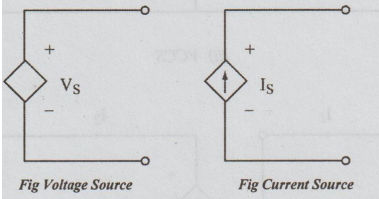
Dependent
sources are also known as controlled sources. In case of dependent sources,
voltage and current are not fixed. In this case, voltage or current is
dependent on the voltage or current existing at some other location in the
circuit. Such sources are represented as shown below by a diamond shape.
Voltage source is marked with polarities and the current source is shown by an
arrow.
Controlled
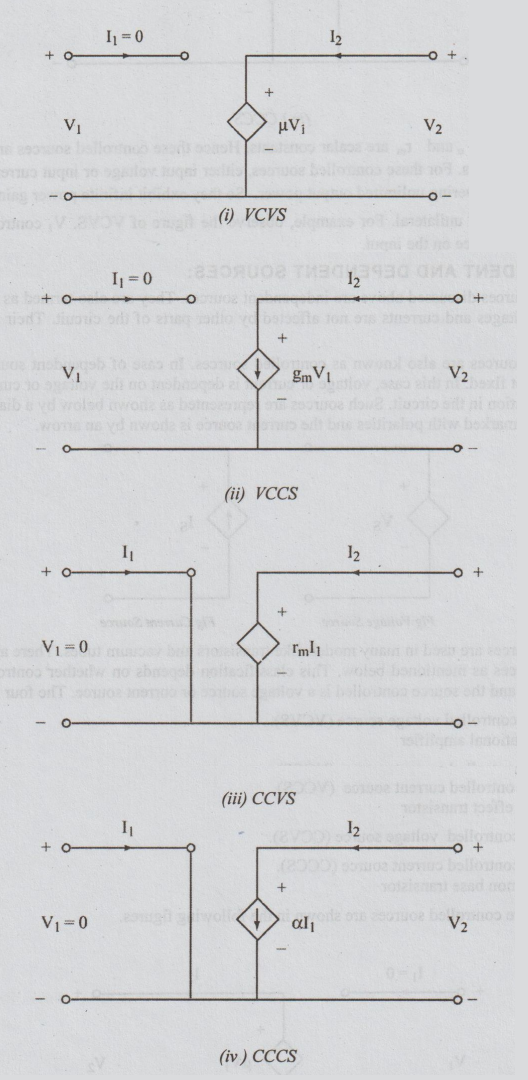
sources are used in many models like transistors and vacuum tubes. There are
four types of controlled sources as mentioned below. This classification
depends on whether control variable is voltage or current and the source
controlled is a voltage source or current source. The four types are
(i)
Voltage-controlled voltage source (VCVS). Eg. Operational amplifier
(ii)
Voltage controlled current source (VCCS). Eg. Field effect transistor
(iii)
Current-controlled voltage source (CCVS).
(iv)
Current-controlled current source (CCCS). Eg. Common base transistor
The
above controlled sources are shown in the following figures.
The
factors μ, gm, α and rm are scalar constants. Hence these
controlled sources are linear, time - variant active elements. For these
controlled sources, either input voltage or input current is zero and they are
capable of delivering unlimited output power. So they exhibit infinite power
gain.
Controlled
source is unilateral. For example, observe the figure of VCVS. V1 controls
the output V2.But I2 has no influence on the input.
Electric Circuit Analysis: Unit I: a. Introduction : Tag: : Electric Circuit Analysis - Independent and dependent sources
Electric Circuit Analysis: Unit I: a. Introduction
Under Subject
Electric Circuit Analysis
EE3251 2nd Semester 2021 Regulation | 2nd Semester EEE Dept 2021 Regulation
Circuits and Network Analysis
EC25C02 2nd Semester ECE Dept | 2025 Regulation | 2nd Semester 2025 Regulation
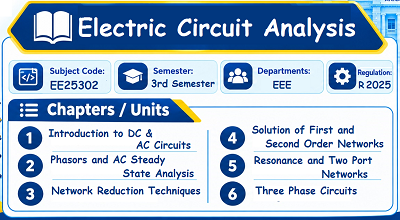
Electric Circuit Analysis
EE25302 3rd Semester EEE Dept | 2025 Regulation | 3rd Semester 2025 Regulation
Related Subjects
Professional English II
HS3251 2nd Semester 2021 Regulation | 2nd Semester Common to all Dept 2021 Regulation
Statistics and Numerical Methods
MA3251 2nd Semester 2021 Regulation M2 Engineering Mathematics 2 | 2nd Semester Common to all Dept 2021 Regulation
Engineering Graphics
GE3251 eg 2nd semester | 2021 Regulation | 2nd Semester Common to all Dept 2021 Regulation
Physics for Electrical Engineering
PH3202 2nd Semester 2021 Regulation | 2nd Semester EEE Dept 2021 Regulation
Basic Civil and Mechanical Engineering
BE3255 2nd Semester 2021 Regulation | 2nd Semester EEE Dept 2021 Regulation
Electric Circuit Analysis
EE3251 2nd Semester 2021 Regulation | 2nd Semester EEE Dept 2021 Regulation
Physics for Electronics Engineering
PH3254 - Physics II - 2nd Semester - ECE Department - 2021 Regulation | 2nd Semester ECE Dept 2021 Regulation
Electrical and Instrumentation Engineering
BE3254 - 2nd Semester - ECE Dept - 2021 Regulation | 2nd Semester ECE Dept 2021 Regulation
Circuit Analysis
EC3251 - 2nd Semester - ECE Dept - 2021 Regulation | 2nd Semester ECE Dept 2021 Regulation
Materials Science
PH3251 2nd semester Mechanical Dept | 2021 Regulation | 2nd Semester Mechanical Dept 2021 Regulation
Basic Electrical and Electronics Engineering
BE3251 2nd semester Mechanical Dept | 2021 Regulation | 2nd Semester Mechanical Dept 2021 Regulation
Physics for Civil Engineering
PH3201 2021 Regulation | 2nd Semester Civil Dept 2021 Regulation
Basic Electrical, Electronics and Instrumentation Engineering
BE3252 2021 Regulation | 2nd Semester Civil Dept 2021 Regulation
Physics for Information Science
PH3256 2nd Semester CSE Dept | 2021 Regulation | 2nd Semester CSE Dept 2021 Regulation
Basic Electrical and Electronics Engineering
BE3251 2nd Semester CSE Dept 2021 | Regulation | 2nd Semester CSE Dept 2021 Regulation
Programming in C
CS3251 2nd Semester CSE Dept 2021 | Regulation | 2nd Semester CSE Dept 2021 Regulation