Electric Circuit Analysis: Unit I: a. Introduction
Short circuit (sc)
Explanation with circuit Diagram, Illustration
Short circuit between any two points can be defined in terms of a figure. If a circuit element is replaced by a short length of an ideal conductor, the terminals are said to be short circuited
SHORT CIRCUIT
(SC)
Short
circuit between any two points can be defined in terms of a figure. If a
circuit element is replaced by a short length of an ideal conductor, the
terminals are said to be short circuited
The
voltage across the short circuit is always zero regardless of the current
through it. The current in the short circuit depends upon the circuit connected
to the terminals. Thus, a short circuit is a two- terminal element for which
voltage must be zero when the current is not zero.
Mathematically,
V(t) = 0, i(t) ≠ 0.
A
short length of copper or aluminium wire can be used for short circuiting.

The
concept of short circuit can be clearly understood from the following
illustrations.
Illustration
1:
Consider
the circuit given below. Here, the terminals C and D are short circuited.

i.e.,
R2 is short circuited. Between C and D, the resistance is 0. The
effective resistance to the source, V1= R1 + 0 = R1
Current from the source
I1
= V1 / R1
All
this current will flow through the short circuited path.
Note
1: If there is one more short circuit between C and D,
the current through each short circuited path is equal to I1 / 2
2:
If there are n short circuit paths between C and D, the current through each
path is equal to I1 / n.
Illustration 2:
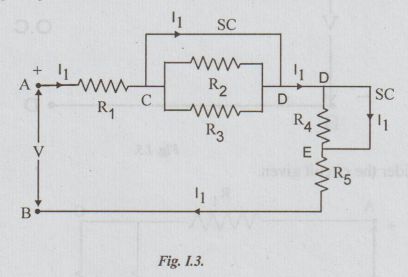
Consider
circuit in the figure. Between terminals C and D, there are 3 parallel paths.
One of them is a short circuit. So all the current flowing through R1
flows through this short circuit.
It
will not flow through R2 or R3. Again, between D and E
terminals, there is a short circuit. The current through this path is I1
as shown in the figure. Current through R5 is I1.
The
total resistance to the source is
=
RAC+ RCD+ RDE + REB = R1+0+0+
R5
=
R1 + R5
So,
I1 = V / R1+R5 {ohm's law}
Note:
1.
The resistance R2, R3 R4 are not effective,
whatever may be their values. It is because they are short circuited.
2.
The current through resistances which are short circuited will always be zero.
Electric Circuit Analysis: Unit I: a. Introduction : Tag: : Explanation with circuit Diagram, Illustration - Short circuit (sc)
Electric Circuit Analysis: Unit I: a. Introduction
Under Subject
Electric Circuit Analysis
EE3251 2nd Semester 2021 Regulation | 2nd Semester EEE Dept 2021 Regulation
Circuits and Network Analysis
EC25C02 2nd Semester ECE Dept | 2025 Regulation | 2nd Semester 2025 Regulation
Electric Circuit Analysis
EE25302 3rd Semester EEE Dept | 2025 Regulation | 3rd Semester 2025 Regulation
Related Subjects
Professional English II
HS3251 2nd Semester 2021 Regulation | 2nd Semester Common to all Dept 2021 Regulation
Statistics and Numerical Methods
MA3251 2nd Semester 2021 Regulation M2 Engineering Mathematics 2 | 2nd Semester Common to all Dept 2021 Regulation
Engineering Graphics
GE3251 eg 2nd semester | 2021 Regulation | 2nd Semester Common to all Dept 2021 Regulation
Physics for Electrical Engineering
PH3202 2nd Semester 2021 Regulation | 2nd Semester EEE Dept 2021 Regulation
Basic Civil and Mechanical Engineering
BE3255 2nd Semester 2021 Regulation | 2nd Semester EEE Dept 2021 Regulation
Electric Circuit Analysis
EE3251 2nd Semester 2021 Regulation | 2nd Semester EEE Dept 2021 Regulation
Physics for Electronics Engineering
PH3254 - Physics II - 2nd Semester - ECE Department - 2021 Regulation | 2nd Semester ECE Dept 2021 Regulation
Electrical and Instrumentation Engineering
BE3254 - 2nd Semester - ECE Dept - 2021 Regulation | 2nd Semester ECE Dept 2021 Regulation
Circuit Analysis
EC3251 - 2nd Semester - ECE Dept - 2021 Regulation | 2nd Semester ECE Dept 2021 Regulation
Materials Science
PH3251 2nd semester Mechanical Dept | 2021 Regulation | 2nd Semester Mechanical Dept 2021 Regulation
Basic Electrical and Electronics Engineering
BE3251 2nd semester Mechanical Dept | 2021 Regulation | 2nd Semester Mechanical Dept 2021 Regulation
Physics for Civil Engineering
PH3201 2021 Regulation | 2nd Semester Civil Dept 2021 Regulation
Basic Electrical, Electronics and Instrumentation Engineering
BE3252 2021 Regulation | 2nd Semester Civil Dept 2021 Regulation

Physics for Information Science
PH3256 2nd Semester CSE Dept | 2021 Regulation | 2nd Semester CSE Dept 2021 Regulation
Basic Electrical and Electronics Engineering
BE3251 2nd Semester CSE Dept 2021 | Regulation | 2nd Semester CSE Dept 2021 Regulation
Programming in C
CS3251 2nd Semester CSE Dept 2021 | Regulation | 2nd Semester CSE Dept 2021 Regulation