Physics for Electrical Engineering: Unit I: Dielectric Materials and Insulation
Ferroelectricity
Definition, Examples, Dielectric hysteresis, Properties and Application of ferroelectric materials
When a dielectric material is subjected to an external electrical field, the dipole moments tend to orient themselves in the direction of the applied electrical field. This results in a finite polarisation. The polarisation increases linearly with the applied electrical field.
FERROELECTRICITY
When
a dielectric material is subjected to an external electrical field, the dipole
moments tend to orient themselves in the direction of the applied electrical
field. This results in a finite polarisation. The polarisation increases
linearly with the applied electrical field.
When the electrical field is
removed the polarisation becomes zero, because the dipole moments go back to
the random orientation configuration.
There are certain materials which
exhibit electric polarisation even in the absence of the applied electrical
field. They are known as Ferroelectric materials. These are permanent dipole
moment in each atom or molecule.
Materials which exhibit electric
polarization even in the absence of the applied electric field are known as
ferroelectric materials.
The
dielectric constant (εr) of these materials is some three orders of
magnitude larger than the ordinary dielectrics.
Ferroelectricity is a result of
dielectric hysteresis. Since these materials exhibit hysteresis effects,
similar to those observed in ferromagnetic materials, they are called
ferroelectric materials.
So
they are called as ferro dielectric materials.
Ferroelectricity refers to the
creation of enormous value of induced dipole moment in a weak electrical field
as well as existence of electric polarisation even in the absence of applied
electrical field.
Examples:
1. Barium titanate (BaTiO3)
2. Potassium dihydrogen phosphate
(KH2PO4)
3. Ammonium dihydrogen phosphate
(NH4H2PO4)
4. Lithium Niobate (LiNbO3)
5. Rochelle salt (NaKC4H4O6
4H2O)
Dielectric hysteresis:
Most
important feature of exhibit ferroelectrics is that they hysteresis similar to
thatferromagnetic materials.
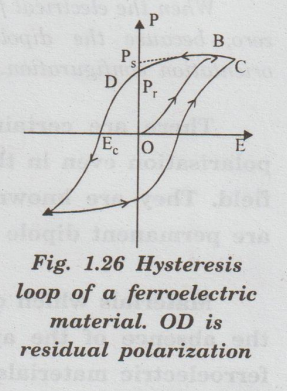
Lagging of polarisation behind the
applied electric field is called dielectric hysteresis. Ferroelectricity is a
result of dielectric hysteresis. (Fig. 1.26)
A
ferroelectric is highly dependent on temperature. When a ferroelectric is
heated, at a temperature called Curie temperature (θ), the ferroelectric
becomes a paraelectric.
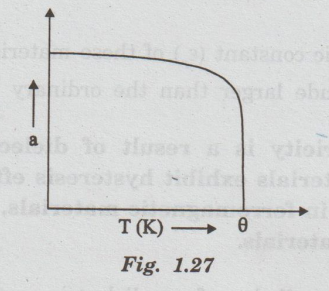
Figure
1.27(a) shows the temperature dependence of polarization of a ferroelectric. A
ferroelectric shows domain structure where, in each domain, all the dipoles are
aligned in the same direction. The ferroelectric susceptibility (Xe)
can be written as
Xe
= C / T- θ ...(1)
where
C is called Curie constant and θ is called the Curie temperature. Equation (15)
is called Curie-Weiss law.
Properties of ferroelectric materials
1.
These materials have permanent dipole moment in each atom or molecule
2.
Ferroelectric materials can be easily polarised even by very weak electrical
field
3.
High value of dielectric constant
The
ferroelectric materials have got very high dielectric constants roughly 3 times
greater than that of ordinary dielectric.
4.
Dependence of the dielectric constant on
temperature
The
dielectric constants of ordinary dielectrics do not change much with
temperature. In the case of ferroelectric crystal, εr exhibits one
or more sharp maxima where εr reaches a value of several thousands.
The temperature at which these maxima occur are called curie temperature.
5.
Ferroelectric is a non linear dependence of its polarisation on the external
electrical field. In ordinary dielectrics, the polarisation P varies linearly
with 'E'. Thus, ordinary dielectrics are often called as linear dielectrics But
the relation between P and E is complex in nature and therefore non linear.
From this point ferroelectrics are know as non
– liner dielectrics.
6.
Ferroelectric materials posses spontaneous polarisation which is a polarisation
that persists when the applied electrical field is zero.
7.
They exhibit domain structure as in the case of ferromagnetic materials.
Application of ferroelectric materials
1.
ferroelectric materials are used to make pressure transducers, ultrasonic
transducers, microphones and gas filters.
2.
Some ferroelectric semiconductors like BaTiO3 - SrTiO3,
BaTiO3 – PbTiO3 and SrTiO3 - PbTiO3
are used to make resistors which are used to measure and control temperature
like thermistors.
3. Electrets are ferroelectric materials
and are electrostatic analog of permanent magnets. Electrets posses a gross
permanent electric dipole moment. Electrets are used in capacitor, microphones
and gas filters to capture submicron particles by electrostatic attraction.
Further, electret bandages are used over the fractured bones to speed up the
healing process.
4. Capacitors: Ferroelectric ceramics are
used in the manufacture of capacitors. Due to large dielectric constant of the
ferroelectric materials, they are used for storing electric charges in
electrical / electronic circuits.
5.
In optical communication, the ferroelectric crystals are used for optical
modulation.
6.
They are used as frequency stabilizers and crystal controlled oscillators.
7.
The high dielectric constant of ferroelectrics makes them to manufacture small
sized capacitors of high capacitance and to store electric energy.
8.
They can be used as memory devices in computers.
9.
In optical communication, the ferroelectric crystals are used for optical
modulation.
10.
They are used in electrotransducers such as microphones.
11.
Ferroelectric crystals exhibit piezoelectric property, which can be used to
produce ultrasonic waves.
12.
Piezoelectric acoustic transducers and pyroelectric infrared detectors are the
devices based also on ferroelectrics.
Physics for Electrical Engineering: Unit I: Dielectric Materials and Insulation : Tag: : Definition, Examples, Dielectric hysteresis, Properties and Application of ferroelectric materials - Ferroelectricity
Physics for Electrical Engineering: Unit I: Dielectric Materials and Insulation
Under Subject
Physics for Electrical Engineering
PH3202 2nd Semester 2021 Regulation | 2nd Semester EEE Dept 2021 Regulation
Related Subjects

Professional English II
HS3251 2nd Semester 2021 Regulation | 2nd Semester Common to all Dept 2021 Regulation
Statistics and Numerical Methods
MA3251 2nd Semester 2021 Regulation M2 Engineering Mathematics 2 | 2nd Semester Common to all Dept 2021 Regulation
Engineering Graphics
GE3251 eg 2nd semester | 2021 Regulation | 2nd Semester Common to all Dept 2021 Regulation
Physics for Electrical Engineering
PH3202 2nd Semester 2021 Regulation | 2nd Semester EEE Dept 2021 Regulation

Basic Civil and Mechanical Engineering
BE3255 2nd Semester 2021 Regulation | 2nd Semester EEE Dept 2021 Regulation
Electric Circuit Analysis
EE3251 2nd Semester 2021 Regulation | 2nd Semester EEE Dept 2021 Regulation
Physics for Electronics Engineering
PH3254 - Physics II - 2nd Semester - ECE Department - 2021 Regulation | 2nd Semester ECE Dept 2021 Regulation
Electrical and Instrumentation Engineering
BE3254 - 2nd Semester - ECE Dept - 2021 Regulation | 2nd Semester ECE Dept 2021 Regulation
Circuit Analysis
EC3251 - 2nd Semester - ECE Dept - 2021 Regulation | 2nd Semester ECE Dept 2021 Regulation
Materials Science
PH3251 2nd semester Mechanical Dept | 2021 Regulation | 2nd Semester Mechanical Dept 2021 Regulation

Basic Electrical and Electronics Engineering
BE3251 2nd semester Mechanical Dept | 2021 Regulation | 2nd Semester Mechanical Dept 2021 Regulation

Physics for Civil Engineering
PH3201 2021 Regulation | 2nd Semester Civil Dept 2021 Regulation

Basic Electrical, Electronics and Instrumentation Engineering
BE3252 2021 Regulation | 2nd Semester Civil Dept 2021 Regulation
Physics for Information Science
PH3256 2nd Semester CSE Dept | 2021 Regulation | 2nd Semester CSE Dept 2021 Regulation
Basic Electrical and Electronics Engineering
BE3251 2nd Semester CSE Dept 2021 | Regulation | 2nd Semester CSE Dept 2021 Regulation
Programming in C
CS3251 2nd Semester CSE Dept 2021 | Regulation | 2nd Semester CSE Dept 2021 Regulation